

Nazi Reich Labor Service Flag Horst Wessel – 3 X 5 ft. Standard
$29.95
In stock



Reichsarbeitsdienst (RAD) Section Flag — “Horst Wessel” Unit, Nazi Reich Labor Service, 3×5 Feet
A Rare Reproduction of One of the Third Reich’s Most Distinctive Organizational Flags
The Reichsarbeitsdienst (RAD) Section Flag of the “Horst Wessel” unit is one of the most visually complex and historically layered organizational flags of the Third Reich — a striking reproduction of the official standard carried by sections of Nazi Germany’s compulsory state labor service. With its rich symbolism, distinctive insignia, and unit-specific identification, this flag is a compelling piece for serious collectors, historians, and theatrical productions requiring precise period accuracy.
A Note on Display & Legality
This flag is presented strictly in its historical context. We strongly recommend it be displayed only in historical, educational, theatrical, or museum settings. Displaying this flag outside of those contexts carries significant potential for offense given its association with the Nazi regime.
Legal notice: While display of this flag is protected under the First Amendment in the United States, it is illegal to display or possess in Germany, Austria, France, Poland, and several other countries outside of authorized educational and artistic contexts. We ship worldwide — it is the buyer’s sole responsibility to understand and comply with the laws of their country.
Design & Symbolism of the RAD Section Flag
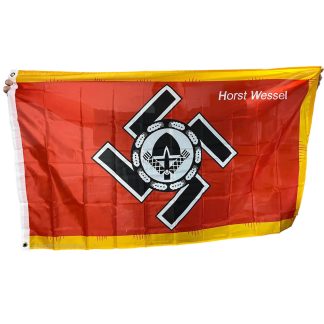
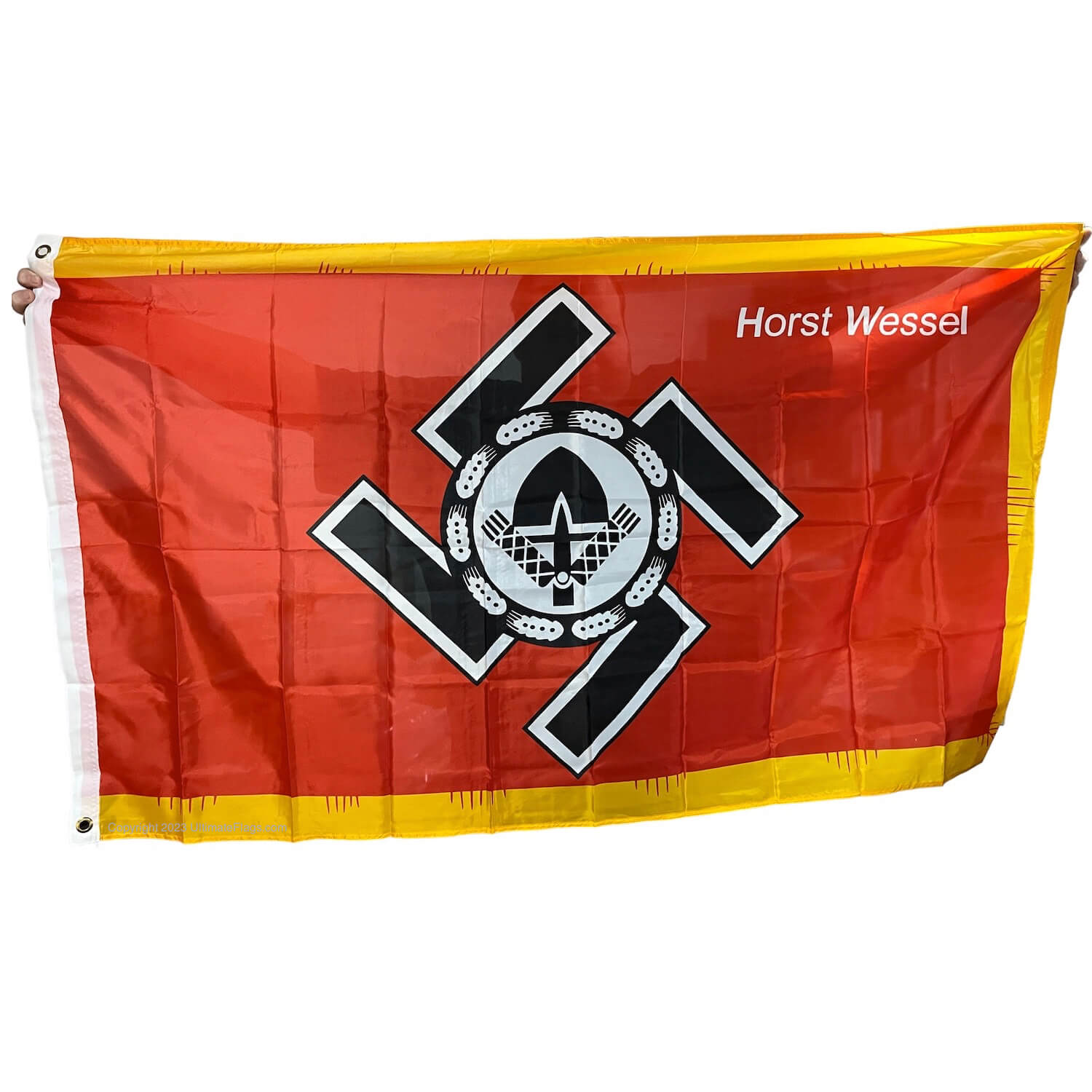
This RAD Abteilungsfahne (Section Flag) is a visually rich and highly specific organizational standard. Its design elements include:
- A bold red field — the primary color of the Nazi Party and virtually all Third Reich organizational flags
- A centered black swastika with white border — the ubiquitous symbol of the Third Reich, incorporated into the flags of every major Nazi organization
- At the center of the swastika, a white wreath encircling a white disc bearing the distinctive Reichsarbeitsdienst insignia — a vertical spade pointed upward, flanked by two stylized ears of wheat — the emblematic tools of the labor service representing both agricultural work and the militarized dignity of manual labor
- The unit designation “Horst Wessel” in white lettering in the upper fly of the flag
- A golden border framing the entire design — a mark of the flag’s status as an official organizational section standard
History of the Reichsarbeitsdienst
The Reichsarbeitsdienst (German: Reich Labour Service, abbreviated RAD) was one of the Third Reich’s most ambitious social engineering projects — a compulsory state labor organization designed to serve simultaneously as an economic tool, a political indoctrination machine, and a pre-military training ground for the youth of Nazi Germany.
The RAD grew out of earlier Weimar-era voluntary labor programs established to combat the catastrophic unemployment of the Great Depression, which had seen German unemployment peak at over six million workers by 1932. When the Nazis came to power in 1933, they transformed these voluntary programs into a compulsory state institution under the leadership of Reichsarbeitsführer Konstantin Hierl.
From June 1935 onward, following the reintroduction of military conscription, service in the RAD became compulsory for all German men aged 18 to 25 — typically served as a six-month obligation immediately preceding military service in the Wehrmacht. At its peak the RAD comprised hundreds of organized sections, each carrying its own Abteilungsfahne (Section Flag) bearing the unit’s designation.
RAD laborers were employed on major infrastructure projects throughout Germany — most notably the construction of the Reichsautobahn motorway network, land reclamation projects, and agricultural work. The organization was designed as much to militarize and indoctrinate its members with Nazi ideology as it was to put them to work — RAD members lived in barracks, drilled with spades instead of rifles, and were subjected to intensive Nazi political education.
During World War II, the RAD’s role expanded dramatically. Compulsory service was extended to young women through the RAD weiblicher Jugend (RADwJ), who served in agricultural, domestic, and administrative support roles. Male RAD units increasingly served as auxiliary formations supporting the Wehrmacht — performing rear-area logistics, anti-aircraft duties, construction under fire, and eventually direct combat support roles as Germany’s manpower crisis deepened in the final years of the war.
Who Was Horst Wessel?
Horst Wessel (1907–1930) was a young SA (Sturmabteilung) commander and Nazi Party activist in Berlin who was shot by a Communist Party member in January 1930 and died of his wounds in February 1930. The Nazi Party, under Joseph Goebbels’ masterful propaganda direction, immediately transformed Wessel into the premier martyr of the Nazi movement.
Before his death, Wessel had written the lyrics to a march that became known as the “Horst-Wessel-Lied” — which the Nazis elevated to the status of a co-national anthem, sung alongside Deutschland über alles at virtually every official Nazi Party event and ceremony throughout the Third Reich. The song began with the famous lines “Die Fahne hoch” (“Raise the Flag High”) — making it perhaps the most recognized piece of Nazi propaganda music in history.
Wessel’s name was attached to numerous Nazi organizations, military units, and institutions throughout the Third Reich as an act of ongoing political commemoration — including this RAD section, the 17th SS Panzergrenadier Division “Götz von Berlichingen” (which briefly bore his name), and streets, schools, and public squares across Germany.
Frequently Asked Questions & Little-Known Facts
Q: What does the RAD spade-and-wheat insignia symbolize? The upward-pointing spade represented the dignity and honor of manual labor — the RAD deliberately militarized the spade as a symbolic substitute for the rifle, with RAD members drilling and parading with spades on their shoulders in the manner of soldiers carrying weapons. The ears of wheat flanking the spade represented agricultural productivity and the Nazi ideal of blood-and-soil (Blut und Boden) — the ideological glorification of Germany’s rural and agricultural identity.
Q: How large was the RAD? At its peak wartime strength the RAD comprised approximately 350,000 men in organized sections across Germany and occupied Europe, supplemented by a separate women’s division of similar scale. It was one of the largest compulsory labor organizations in modern history.
Q: Did RAD units see combat? Yes — particularly in the final years of the war. As Germany’s military manpower was exhausted, RAD units were increasingly deployed in anti-aircraft (Flak) batteries, combat engineer roles, rear-area security, and ultimately direct infantry combat on both the Eastern and Western Fronts in 1944–45.
Q: What is the ancient history of the swastika? The swastika predates the Nazi Party by thousands of years — used as a sacred symbol of good fortune in Hinduism, Buddhism, and Jainism for over 5,000 years and remaining in widespread use across Asia today. In the United States it appeared on Coca-Cola promotional items, Boy Scout insignia, and commercial products before World War II permanently transformed its meaning in Western culture.
Q: Is this flag still used today? This specific flag design is no longer used in any official capacity. Some fringe groups continue to use Third Reich organizational flags in unofficial contexts. This listing is intended exclusively for historical, educational, and theatrical use.
Standard Quality — Super-Weave Polyester, 3×5 Feet
Our most popular quality level — lightweight enough to fly in the slightest breeze, durable enough for long-term display.
- Through-dyed on both sides — design fully visible from either direction
- Bright, fade-resistant dye for lasting color in indoor and fair-weather outdoor use
- 100% synthetic super-weave polyester — lightweight, waterproof, and responsive in minimal wind
- Double-stitched edges on all sides for lasting durability
- Reinforced grommet holes with metal rings for secure, rust-free pole attachment
- Fits any standard flagpole or mounting system
Recommended Uses
- WWII reenactments and living history events
- Theatrical productions — film, television, and stage
- Indoor museum and historical displays
- Academic and educational exhibitions
- Collectors of Third Reich organizational, labor service, and political history artifacts
- Fair-weather outdoor display
Premium Quality Cotton Polehem Sewn Nazi Banner 3 x 5
See Nazi Germany Flag Collection Here.
Check out our entire WW2 Nazi Flag Collection Here.
We are adding more and more daily!
“At Ultimate Flags Inc., we are more than just a flag store; we are custodians of history, supporters of freedom, and believers in the power of symbols. Located in O’Brien, Florida, our family-owned business has been serving patriots, history enthusiasts, and flag collectors since 1997. We pride ourselves on offering an unparalleled selection of over 10,000 flags, including American flags, Confederate flags, military flags, historic flags, and custom designs. Each flag tells a story, and we are committed to preserving these narratives through our high-quality products.
Our passion for flags is matched only by our dedication to our customers. Whether you’re seeking a flag for personal expression, historical reenactments, or to honor your heritage, our experienced team is here to help you find the perfect flag. We understand the importance of quality, which is why we offer flags in various materials and sizes, suitable for all needs and occasions.
At Ultimate Flags, we believe in giving back. We actively support veterans, first responders, and non-profit organizations, ensuring that the brave men and women who serve our country are honored and remembered. Our online presence is not just about sales; it’s about educating our audience on the rich tapestry of American history and the significance of flags in our society.
Explore our vast collection in our online flag store and join us in celebrating the virtues, history, and ideas that shape our nation. For Patriots, Pride, & Freedom – Ultimate Flags Inc.”
SKU: C42D3F5-RU-FL3X5P-837324
Description
Description
German Naval Jack — Weimar Republic Era (1921–1933), Iron Cross with German Canton, 3×5 Feet
A Rare Flag from Germany’s Most Turbulent Political Era
The German Naval Jack of 1921–1933 is one of the most historically fascinating and collectible flags of the 20th century — a design that bridges the end of the German Empire and the rise of the Third Reich, born entirely within the brief and turbulent years of the Weimar Republic. Featuring the timeless Iron Cross, the traditional black, white, and red imperial colors, and the German national flag in the canton, this jack captures a Germany torn between its imperial past and an uncertain democratic future.
History & Symbolism of the 1921–1933 German Naval Jack
The Weimar Republic (1919–1933) was established in the aftermath of Germany’s defeat in World War I and the abdication of Kaiser Wilhelm II in November 1918. The new democratic government faced an almost impossible task — governing a nation shattered by military defeat, crippled by the punishing Treaty of Versailles (1919), and bitterly divided between monarchists, republicans, communists, and early Nazi agitators.
One of the Weimar Republic’s most politically charged decisions was the question of national colors and flag identity. The new Republic adopted black, red, and gold as its official national colors — the colors of the liberal revolutionary movement of 1848 — replacing the black, white, and red of the German Empire. This decision was fiercely contested by German nationalists and monarchists, who viewed the new colors as a humiliating repudiation of imperial German heritage.
The German Naval Jack adopted in 1921 reflected this political compromise — incorporating the black, white, and red of the old imperial tradition alongside the new republican identity. Its design combined:
- The black, white, and red field — the colors of the Prussian and imperial German heraldic tradition, drawn from the arms of the Hohenzollern dynasty and the Hanseatic League, representing continuity with Germany’s pre-Weimar military and naval heritage
- A bold black Iron Cross (Eisernes Kreuz) centered on the flag — Germany’s most venerated military symbol, established in 1813 during the Napoleonic Wars and carried through the Franco-Prussian War and World War I as the nation’s premier decoration for battlefield valor
- The German national flag in the canton (upper hoist corner) — incorporating the black, red, and gold tricolor of the Weimar Republic, formally acknowledging the new democratic state’s authority while surrounding it with imperial colors that many in the German Navy still preferred
This design tension — republican colors in the canton, imperial colors dominating the field — perfectly encapsulates the fundamental instability of the Weimar Republic itself, which was perpetually caught between democratic legitimacy and the gravitational pull of its imperial past.
The flag was in use from 1921 until 1933, when Adolf Hitler’s appointment as Chancellor and the subsequent Nazi seizure of power (Machtergreifung) brought an end to the Weimar Republic and its flag designs. The black, red, and gold republican tricolor was abolished and replaced with the black, white, and red of the imperial era — and ultimately the swastika flag — as the Nazis deliberately reclaimed imperial German symbolism and rejected the Weimar democratic heritage entirely.
Frequently Asked Questions & Little-Known Facts
Q: Why did the Weimar Republic keep imperial colors in its naval jack? The German Navy (Reichsmarine) of the Weimar era was deeply conservative and largely monarchist in its officer culture — a reflection of the Imperial German Navy’s traditions and the class backgrounds of its officers. The retention of black, white, and red in the naval jack was a political concession to naval tradition and to the powerful nationalist factions within German society who refused to accept the republican colors as legitimate.
Q: What was the Weimar Republic and why did it fail? The Weimar Republic (1919–1933) was Germany’s first democratic government — established under enormous pressure following WWI defeat, burdened from birth by the “stab-in-the-back” myth promoted by German nationalists who falsely blamed civilian politicians for Germany’s military defeat. It survived multiple crises — the hyperinflation of 1923, multiple coup attempts including Hitler’s Beer Hall Putsch (1923), and the devastating Great Depression (1929) — before finally collapsing when President Paul von Hindenburg appointed Hitler as Chancellor in January 1933.
Q: What happened to the Weimar Republic’s black, red, and gold flag? Upon the Nazi seizure of power in 1933, the black, red, and gold tricolor was immediately abolished and replaced with the imperial black, white, and red — and then progressively with the swastika flag. The black, red, and gold was restored as Germany’s national flag following World War II and remains the flag of the Federal Republic of Germany today.
Q: What is the Iron Cross’s significance in this flag? The Iron Cross on this jack connects the Weimar Republic’s naval identity directly to 800 years of German military heritage — from the Teutonic Knights of the 13th century through the Napoleonic Wars, the Franco-Prussian War, and World War I. Its presence on a republican-era flag was a deliberate statement that the new Germany, whatever its political form, maintained continuity with the military traditions and sacrifices of the old.
Q: Is this flag associated with the Nazi regime? No — this flag was retired in 1933 when the Nazis came to power and abolished Weimar-era symbols. It is an exclusively Weimar Republic era design with no direct Nazi association, making it one of the more historically straightforward German flags of the early 20th century for collectors and historians.
Standard Quality — Super-Weave Polyester, 3×5 Feet
Our most popular quality level — durable, lightweight, and built to fly in even the lightest breeze.
- Through-dyed on both sides — design fully visible from either direction
- Bright, fade-resistant dye for lasting color in indoor and fair-weather outdoor use
- 100% synthetic super-weave polyester — lightweight, waterproof, and highly responsive in minimal wind
- Double-stitched edges on all sides for lasting durability
- Reinforced grommet holes with metal rings for secure, rust-free pole attachment
- Fits any standard flagpole or mounting system
Recommended Uses
- Weimar Republic and WWI-era reenactments and living history events
- Theatrical productions — film, television, and stage
- Indoor museum and historical displays
- Academic and educational exhibitions
- Collectors of Imperial German, Weimar Republic, and early 20th century German naval history
- Fair-weather outdoor display, events, and parades
Premium Quality Cotton Polehem Sewn Nazi Banner 3 x 5
See Nazi Germany Flag Collection Here.
Check out our entire WW2 Nazi Flag Collection Here.
We are adding more and more daily!
“At Ultimate Flags Inc., we are more than just a flag store; we are custodians of history, supporters of freedom, and believers in the power of symbols. Located in O’Brien, Florida, our family-owned business has been serving patriots, history enthusiasts, and flag collectors since 1997. We pride ourselves on offering an unparalleled selection of over 10,000 flags, including American flags, Confederate flags, military flags, historic flags, and custom designs. Each flag tells a story, and we are committed to preserving these narratives through our high-quality products.
Our passion for flags is matched only by our dedication to our customers. Whether you’re seeking a flag for personal expression, historical reenactments, or to honor your heritage, our experienced team is here to help you find the perfect flag. We understand the importance of quality, which is why we offer flags in various materials and sizes, suitable for all needs and occasions.
At Ultimate Flags, we believe in giving back. We actively support veterans, first responders, and non-profit organizations, ensuring that the brave men and women who serve our country are honored and remembered. Our online presence is not just about sales; it’s about educating our audience on the rich tapestry of American history and the significance of flags in our society.
Explore our vast collection in our online flag store and join us in celebrating the virtues, history, and ideas that shape our nation. For Patriots, Pride, & Freedom – Ultimate Flags Inc.”
SKU: C21D1F7-RU-FL3X5P-354-830363
Recently Viewed Flags

Logan
 Customer
5/5
Beautiful, rare flag
1 month ago

 Unhappy With Your Product? We’ll Take It Back!