


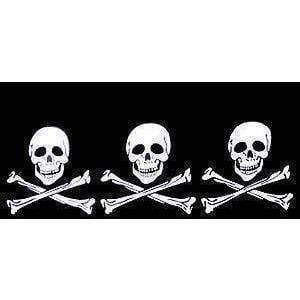
Pirate Flag Christopher Condent Triple Threat Flag 3 Skulls Flag 3 X 5 ft. Standard
$24.95
In stock




Christopher Condent “Three Skulls” Jolly Roger Pirate Flag — 3×5 ft | Standard Quality
Triple the Warning, Triple the Threat
Most pirates flew one skull. Christopher Condent flew three.
Where the standard Jolly Roger offered a single death’s head as its threat, Condent’s flag multiplied the warning across the entire black field — three skulls, each with crossed bones, leaving absolutely nothing to the imagination. It was an escalation of the visual language every sailor already feared, and it worked exactly as intended.
Christopher Condent — The Pirate Who Got Out Alive
Condent’s story is unusual among Golden Age pirates for one simple reason: he survived. Not captured, not hanged, not killed in battle — he retired comfortably, remarried well, and died in peace. In an era when the gallows at Execution Dock claimed so many of his contemporaries, Condent’s exit from piracy stands as one of the more remarkable endings of the period.
Active primarily between 1718 and 1720, Condent began his pirate career in the Caribbean before shifting operations to the West African coast and then the Indian Ocean — the same fertile hunting grounds pioneered by Thomas Tew and Henry Every before him. The Indian Ocean trade routes remained extraordinarily lucrative: Mughal merchant vessels, East India Company ships, and Arab trading dhows all moved wealth in quantities that made the Atlantic seem modest by comparison.
Condent’s most significant capture came in the Indian Ocean when his crew took a large Arab vessel carrying a cargo estimated to be worth a substantial fortune, reportedly divided among the crew in shares that left every man wealthy by the standards of the day.
The Three Skulls — What Did They Mean?
The precise symbolism behind Condent’s triple skull design has been debated. The most widely cited interpretation holds that the three skulls represented death in its totality — the destruction of body, mind, and soul — a complete annihilation of the self rather than simple physical threat. It was a theological escalation: not just we will kill you but we will unmake you entirely.
A more practical reading is that Condent simply understood the psychology of visual escalation. One skull was a threat. Three skulls tripled the psychological impact on the deck of an approaching merchant vessel, where sailors were already terrified and looking for any reason to convince their captain to surrender.
Either interpretation served the same purpose. The flag was designed to break morale before a single gun was loaded.
The French Pardon and Retirement
Unlike most of his contemporaries, Condent didn’t seek the British Act of Grace — the 1718 pardon offered by Governor Woodes Rogers that drew many pirates out of Nassau. Instead, Condent made his way to the French island of Bourbon (present-day Réunion) in the Indian Ocean, where he negotiated a French pardon and settled.
He married the niece of the island’s governor, converted his plunder into legitimate capital, and eventually relocated to St. Malo in France — a port city with a long tradition of privateering and maritime trade. There he became a merchant and lived out his days in comfort, as far from the gallows as a former pirate could reasonably get.
It was an exit that Blackbeard, Bartholomew Roberts, and Walter Kennedy never managed.
Flag Details & Construction
Quality Tier: Standard Quality
- Size: 3 feet x 5 feet
- Material: Super-weave polyester — 100% synthetic, waterproof
- Dye: Through-dyed design visible on both sides
- Edges: Double-stitched throughout
- Header: Reinforced brass grommet rings for easy pole attachment
- Lightweight — flies well in fair-weather breeze
Recommended Uses
- Outdoor fair-weather pole display
- Pirate-themed events, parties, and Renaissance fairs
- Halloween and seasonal decoration
- Man cave, game room, and nautical-themed décor
- Indoor wall display
- Gift for Golden Age of Piracy enthusiasts and maritime history buffs
Frequently Asked Questions
Why does Condent’s flag have three skulls instead of one? Condent’s triple skull design is one of the most distinctive of the Golden Age. The three skulls are commonly interpreted as representing the total destruction of body, mind, and soul — a complete annihilation rather than simple physical death. Practically speaking, it was also a calculated escalation of the fear factor built into standard Jolly Roger imagery.
Is this flag historically documented? Yes — Condent’s three-skull flag is among the documented designs of the Golden Age of Piracy, making it a genuine historical flag rather than a novelty design.
What made the Indian Ocean such a popular target for pirates? The Indian Ocean trade routes carried enormous concentrations of wealth — Mughal treasure ships, East India Company vessels, and Arab merchant fleets all moved high-value cargo through relatively unprotected waters. Pirates who made the long voyage from the Atlantic found far richer pickings than the increasingly patrolled Caribbean and North American routes.
Did Condent ever face justice for his piracy? No — Condent successfully negotiated a French pardon, married into colonial society on the island of Bourbon, and retired to St. Malo as a merchant. He is one of the very few prominent Golden Age pirates who ended his career through retirement rather than capture or death.
What was the Act of Grace? The Act of Grace was a British royal pardon offered in 1718, delivered through Governor Woodes Rogers in Nassau, that promised amnesty to pirates who surrendered and renounced piracy. It successfully drew many pirates out of active service but was rejected by others — including Bartholomew Roberts — who continued operating until killed or captured.
Is this flag suitable for outdoor display? Yes — super-weave polyester handles fair-weather outdoor conditions well and flies easily in light breeze, making it a solid choice for seasonal and event display.
Shop Pirate Flags in our Full Collection!
“At Ultimate Flags Inc., we are more than just a flag store; we are custodians of history, supporters of freedom, and believers in the power of symbols. Located in O’Brien, Florida, our family-owned business has been serving patriots, history enthusiasts, and flag collectors since 1997. We pride ourselves on offering an unparalleled selection of over 10,000 flags, including American flags, Confederate flags, military flags, historic flags, and custom designs. Each flag tells a story, and we are committed to preserving these narratives through our high-quality products.
Our passion for flags is matched only by our dedication to our customers. Whether you’re seeking a flag for personal expression, historical reenactments, or to honor your heritage, our experienced team is here to help you find the perfect flag. We understand the importance of quality, which is why we offer flags in various materials and sizes, suitable for all needs and occasions.
At Ultimate Flags, we believe in giving back. We actively support veterans, first responders, and non-profit organizations, ensuring that the brave men and women who serve our country are honored and remembered. Our online presence is not just about sales; it’s about educating our audience on the rich tapestry of American history and the significance of flags in our society.
Explore our vast collection in our online flag store and join us in celebrating the virtues, history, and ideas that shape our nation. For Patriots, Pride, & Freedom – Ultimate Flags Inc.”
SKU: C43D3F3-RU-FL3X5P-984530
Description
Description
German Naval Jack — Weimar Republic Era (1921–1933), Iron Cross with German Canton, 3×5 Feet
A Rare Flag from Germany’s Most Turbulent Political Era
The German Naval Jack of 1921–1933 is one of the most historically fascinating and collectible flags of the 20th century — a design that bridges the end of the German Empire and the rise of the Third Reich, born entirely within the brief and turbulent years of the Weimar Republic. Featuring the timeless Iron Cross, the traditional black, white, and red imperial colors, and the German national flag in the canton, this jack captures a Germany torn between its imperial past and an uncertain democratic future.
History & Symbolism of the 1921–1933 German Naval Jack
The Weimar Republic (1919–1933) was established in the aftermath of Germany’s defeat in World War I and the abdication of Kaiser Wilhelm II in November 1918. The new democratic government faced an almost impossible task — governing a nation shattered by military defeat, crippled by the punishing Treaty of Versailles (1919), and bitterly divided between monarchists, republicans, communists, and early Nazi agitators.
One of the Weimar Republic’s most politically charged decisions was the question of national colors and flag identity. The new Republic adopted black, red, and gold as its official national colors — the colors of the liberal revolutionary movement of 1848 — replacing the black, white, and red of the German Empire. This decision was fiercely contested by German nationalists and monarchists, who viewed the new colors as a humiliating repudiation of imperial German heritage.
The German Naval Jack adopted in 1921 reflected this political compromise — incorporating the black, white, and red of the old imperial tradition alongside the new republican identity. Its design combined:
- The black, white, and red field — the colors of the Prussian and imperial German heraldic tradition, drawn from the arms of the Hohenzollern dynasty and the Hanseatic League, representing continuity with Germany’s pre-Weimar military and naval heritage
- A bold black Iron Cross (Eisernes Kreuz) centered on the flag — Germany’s most venerated military symbol, established in 1813 during the Napoleonic Wars and carried through the Franco-Prussian War and World War I as the nation’s premier decoration for battlefield valor
- The German national flag in the canton (upper hoist corner) — incorporating the black, red, and gold tricolor of the Weimar Republic, formally acknowledging the new democratic state’s authority while surrounding it with imperial colors that many in the German Navy still preferred
This design tension — republican colors in the canton, imperial colors dominating the field — perfectly encapsulates the fundamental instability of the Weimar Republic itself, which was perpetually caught between democratic legitimacy and the gravitational pull of its imperial past.
The flag was in use from 1921 until 1933, when Adolf Hitler’s appointment as Chancellor and the subsequent Nazi seizure of power (Machtergreifung) brought an end to the Weimar Republic and its flag designs. The black, red, and gold republican tricolor was abolished and replaced with the black, white, and red of the imperial era — and ultimately the swastika flag — as the Nazis deliberately reclaimed imperial German symbolism and rejected the Weimar democratic heritage entirely.
Frequently Asked Questions & Little-Known Facts
Q: Why did the Weimar Republic keep imperial colors in its naval jack? The German Navy (Reichsmarine) of the Weimar era was deeply conservative and largely monarchist in its officer culture — a reflection of the Imperial German Navy’s traditions and the class backgrounds of its officers. The retention of black, white, and red in the naval jack was a political concession to naval tradition and to the powerful nationalist factions within German society who refused to accept the republican colors as legitimate.
Q: What was the Weimar Republic and why did it fail? The Weimar Republic (1919–1933) was Germany’s first democratic government — established under enormous pressure following WWI defeat, burdened from birth by the “stab-in-the-back” myth promoted by German nationalists who falsely blamed civilian politicians for Germany’s military defeat. It survived multiple crises — the hyperinflation of 1923, multiple coup attempts including Hitler’s Beer Hall Putsch (1923), and the devastating Great Depression (1929) — before finally collapsing when President Paul von Hindenburg appointed Hitler as Chancellor in January 1933.
Q: What happened to the Weimar Republic’s black, red, and gold flag? Upon the Nazi seizure of power in 1933, the black, red, and gold tricolor was immediately abolished and replaced with the imperial black, white, and red — and then progressively with the swastika flag. The black, red, and gold was restored as Germany’s national flag following World War II and remains the flag of the Federal Republic of Germany today.
Q: What is the Iron Cross’s significance in this flag? The Iron Cross on this jack connects the Weimar Republic’s naval identity directly to 800 years of German military heritage — from the Teutonic Knights of the 13th century through the Napoleonic Wars, the Franco-Prussian War, and World War I. Its presence on a republican-era flag was a deliberate statement that the new Germany, whatever its political form, maintained continuity with the military traditions and sacrifices of the old.
Q: Is this flag associated with the Nazi regime? No — this flag was retired in 1933 when the Nazis came to power and abolished Weimar-era symbols. It is an exclusively Weimar Republic era design with no direct Nazi association, making it one of the more historically straightforward German flags of the early 20th century for collectors and historians.
Standard Quality — Super-Weave Polyester, 3×5 Feet
Our most popular quality level — durable, lightweight, and built to fly in even the lightest breeze.
- Through-dyed on both sides — design fully visible from either direction
- Bright, fade-resistant dye for lasting color in indoor and fair-weather outdoor use
- 100% synthetic super-weave polyester — lightweight, waterproof, and highly responsive in minimal wind
- Double-stitched edges on all sides for lasting durability
- Reinforced grommet holes with metal rings for secure, rust-free pole attachment
- Fits any standard flagpole or mounting system
Recommended Uses
- Weimar Republic and WWI-era reenactments and living history events
- Theatrical productions — film, television, and stage
- Indoor museum and historical displays
- Academic and educational exhibitions
- Collectors of Imperial German, Weimar Republic, and early 20th century German naval history
- Fair-weather outdoor display, events, and parades
Premium Quality Cotton Polehem Sewn Nazi Banner 3 x 5
See Nazi Germany Flag Collection Here.
Check out our entire WW2 Nazi Flag Collection Here.
We are adding more and more daily!
“At Ultimate Flags Inc., we are more than just a flag store; we are custodians of history, supporters of freedom, and believers in the power of symbols. Located in O’Brien, Florida, our family-owned business has been serving patriots, history enthusiasts, and flag collectors since 1997. We pride ourselves on offering an unparalleled selection of over 10,000 flags, including American flags, Confederate flags, military flags, historic flags, and custom designs. Each flag tells a story, and we are committed to preserving these narratives through our high-quality products.
Our passion for flags is matched only by our dedication to our customers. Whether you’re seeking a flag for personal expression, historical reenactments, or to honor your heritage, our experienced team is here to help you find the perfect flag. We understand the importance of quality, which is why we offer flags in various materials and sizes, suitable for all needs and occasions.
At Ultimate Flags, we believe in giving back. We actively support veterans, first responders, and non-profit organizations, ensuring that the brave men and women who serve our country are honored and remembered. Our online presence is not just about sales; it’s about educating our audience on the rich tapestry of American history and the significance of flags in our society.
Explore our vast collection in our online flag store and join us in celebrating the virtues, history, and ideas that shape our nation. For Patriots, Pride, & Freedom – Ultimate Flags Inc.”
SKU: C21D1F7-RU-FL3X5P-354-830363
Recently Viewed Flags

Christopher G C.
 Customer
5/5
6 months ago
 Unhappy With Your Product? We’ll Take It Back!