

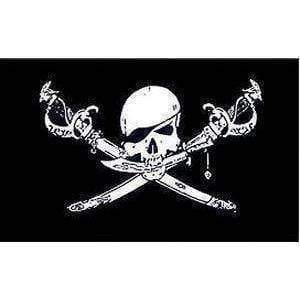
Pirate Flag, Brethren Of the Coast Jolly Roger Flag 5 X 8 ft. Jumbo
$79.95
In stock




Brethren of the Coast Jolly Roger Flag — Caribbean Buccaneers,
Size: 5×8 Feet Jumbo, Standard Polyester
A Commanding Display of the Brotherhood That Invented Modern Piracy
At a commanding 5×8 feet, this jumbo Brethren of the Coast Jolly Roger Flag makes an unmistakable statement at any event, venue, or display. Before the Golden Age of Piracy, before the Jolly Roger, before democratic pirate crews and written articles — there were the Brethren of the Coast. The brotherhood of Caribbean buccaneers who laid the foundation for every pirate tradition that followed. This flag honors the most consequential and least celebrated chapter in the entire history of piracy.
History of the Brethren of the Coast
The Brethren of the Coast (French: Frères de la Côte) were a loose but remarkably organized coalition of buccaneers, privateers, sailors, and soldiers of fortune operating throughout the Caribbean Sea, Atlantic Ocean, and Gulf of Mexico from roughly the 1640s through the early 1700s — targeting primarily Spanish ships and colonial ports during the long European struggle for control of the New World.
They were not merely pirates in the traditional sense. The Brethren operated as a syndicate of captains — many holding letters of marque and reprisal issued by English, French, and Dutch governments — who regulated their privateering enterprises both within their own community and with their outside government benefactors. Primarily Protestant in background and English and French in origin, they occupied a uniquely ambiguous legal space: from Spain’s perspective they were criminals deserving death; from the perspective of the Protestant European powers challenging Spanish colonial dominance, they were a convenient, self-financing military asset.
Their origins were humble. The earliest buccaneers were hunters — French and English outcasts, escaped indentured servants, shipwrecked sailors — who settled on the northern coast of Hispaniola and the island of Tortuga, surviving by hunting wild cattle and smoking the meat on wooden frames the native Arawak called boucans — giving the buccaneers their name. When Spain drove them off Hispaniola and destroyed their settlements, the survivors turned to the sea, armed with longboats, muskets, and a profound personal grievance against Spanish colonial power.
The Articles — Democracy on the High Seas
What truly set the Brethren of the Coast apart — and what makes them one of the most remarkable social experiments in early modern history — was their system of written democratic self-governance, radical by any 17th century standard.
At a time when common sailors on European naval and merchant vessels had essentially no rights, no share of profits, and no protection against abusive officers, the Brethren operated under articles and contracts signed by every crew member before a voyage. These agreements covered:
The division of spoils — distributed by agreed shares, with every crew member receiving a defined portion, and specific financial compensation guaranteed for wounds sustained in battle. A man who lost a hand or eye in combat received a specified payment from the common fund — one of the earliest documented workers’ compensation systems in history.
Officers’ authority and accountability — captains commanded in battle but could be voted out between engagements. An elected quartermaster controlled food and plunder distribution as a check on the captain’s power, ensuring no single individual could dominate the crew’s shared resources.
Conduct rules — covering gambling, drinking, religious observances, the handling of prisoners, and the presence of women aboard — written, agreed, and binding on all.
These articles became the direct template for the pirate codes of the Golden Age that followed. The articles of Bartholomew Roberts, Calico Jack Rackham, and Edward Low all drew explicitly on the traditions the Brethren had established a generation earlier — making the Brethren of the Coast one of the earliest examples of democratic labor organization in the Western world.
Henry Morgan — The Greatest Buccaneer Who Ever Lived
No figure embodies the extraordinary contradictions of the Brethren more completely than Sir Henry Morgan (c.1635–1688) — a Welshman of modest birth who became the most successful military commander in Caribbean history and ended his life as one of its wealthiest and most powerful men.
Born in Llanrhymney, Wales, Morgan arrived in the Caribbean as a young man and rose through buccaneer ranks through tactical genius, personal courage, and an almost supernatural ability to inspire men to follow him into seemingly impossible situations. His campaigns against Spanish colonial possessions remain among the most audacious military operations of the 17th century:
Puerto Príncipe, Cuba (1668) — An overland march through difficult terrain to capture a heavily fortified inland city, establishing Morgan’s reputation as a commander willing to strike where Spain least expected.
Portobelo, Panama (1668) — Morgan recruited his Brethren for an assault on one of the most heavily defended ports in the Spanish New World — the primary terminus of Spain’s South American silver trade — with only 460 men. The attack succeeded through sheer audacity, and Morgan extracted enormous ransom before withdrawing. Contemporary accounts describe him using priests and nuns as human shields during the assault — a detail that scandalized Europe and cemented his fearsome reputation.
Maracaibo, Venezuela (1669) — Trapped in Lake Maracaibo by a Spanish fleet blocking the only exit, Morgan deployed a fire ship — loaded with explosives and sailed unmanned into the Spanish flagship — to destroy the blockade, allowing his entire fleet to escape to open sea in one of the most brilliant naval improvisations of the era.
Panama City (1671) — Morgan’s masterpiece and the greatest buccaneer operation in history. Leading 1,200 men on a grueling ten-day overland march across the Isthmus of Panama through jungle, swamp, and enemy ambushes, he stormed and destroyed Panama City — then the wealthiest city in the Western Hemisphere — extracting wealth that stunned even experienced Caribbean observers.
The sack of Panama proved almost too successful. Spain protested formally to the English Crown, and Morgan was arrested and transported to London — largely for diplomatic show. King Charles II, who had quietly been receiving a share of buccaneer profits for years, knighted Morgan in 1674 and appointed him Lieutenant Governor of Jamaica, where he spent his remaining years hunting the very pirates whose traditions he had helped create, dying peacefully in 1688 as one of the most powerful men in the Caribbean.
Frequently Asked Questions & Little-Known Facts
Q: What is the difference between a buccaneer, a privateer, and a pirate? The distinctions were primarily legal. Privateers held government-issued letters of marque authorizing attacks on enemy shipping — making them legally sanctioned combatants rather than criminals. Buccaneers like the Brethren occupied a grey zone, sometimes holding letters of marque and sometimes not, but generally operating with the tacit approval of Protestant European governments hostile to Spain. Pirates operated without any governmental authorization and were subject to execution under the laws of all nations. The same captain could move between all three categories depending on whether a letter of marque was current and which nation’s court was judging him.
Q: Where was the Brethren’s headquarters? The primary base was Tortuga (Île de la Tortue) — a small island off the northern coast of Hispaniola — which served as the capital of Caribbean buccaneering from the 1630s through the 1680s. Its natural harbor, defensible cliffs, and proximity to major Spanish shipping lanes made it ideal. Port Royal, Jamaica — before its catastrophic destruction in the earthquake of June 7, 1692, which killed an estimated 2,000 people and caused much of the city to slide into the sea — later became equally central to buccaneer operations.
Q: How did the Brethren influence the Golden Age of Piracy? Directly and profoundly. The articles, democratic governance, compensation systems, and tactical traditions of the Brethren were the direct template for Golden Age pirate codes. Many Golden Age pirates had fathers, mentors, or early crewmates who had sailed with the Brethren, and the oral traditions of Caribbean seafaring carried buccaneer customs forward into the next generation. Historians now regard the Brethren of the Coast as the essential link between Caribbean privateering of the 1600s and the outlaw piracy of the 1700s.
Q: Were the Brethren really treated as equals? Within the crew, remarkably yes — the buccaneer articles represented genuine egalitarianism radical by 17th century standards. This equality did not extend to their treatment of enemies, prisoners, or enslaved people, however. Morgan’s campaigns in particular involved significant violence against civilian populations, and the Brethren’s record on the treatment of captives was inconsistent at best.
Q: Why is this flag offered in a jumbo 5×8 foot size? At 5×8 feet, this flag is designed for large outdoor events, commercial venues, boat displays, and major pirate festivals like Gasparilla in Tampa where a standard 3×5 flag simply disappears in the crowd. The jumbo format delivers the commanding visual presence this historic flag deserves.
Standard Quality — Super-Weave Polyester, 5×8 Feet Jumbo
Our most popular quality level — durable, lightweight, and built to fly well in even the lightest breeze, even at jumbo scale.
- Through-printed on both sides — design fully visible from either direction
- Bright, fade-resistant inks for lasting color in indoor and fair-weather outdoor use
- 100% synthetic waterproof super-weave polyester — lightweight and highly responsive in minimal wind
- Double-stitched edges on all sides for lasting durability
- Reinforced grommet holes with metal rings for secure, rust-free pole attachment
- Fits any standard flagpole or mounting system
Recommended Uses
- Gasparilla Festival and large-scale pirate-themed events and parades
- Boats, docks, marinas, and nautical display
- Fair-weather outdoor pole display
- Themed bars, restaurants, event venues, and entertainment spaces
- Indoor display and large-format home or commercial decoration
- Theatrical productions and film sets requiring period buccaneer imagery
- Halloween and seasonal themed decoration
Check out our full Pirate Flag Collection Here
“At Ultimate Flags Inc., we are more than just a flag store; we are custodians of history, supporters of freedom, and believers in the power of symbols. Located in O’Brien, Florida, our family-owned business has been serving patriots, history enthusiasts, and flag collectors since 1997. We pride ourselves on offering an unparalleled selection of over 10,000 flags, including American flags, Confederate flags, military flags, historic flags, and custom designs. Each flag tells a story, and we are committed to preserving these narratives through our high-quality products.
Our passion for flags is matched only by our dedication to our customers. Whether you’re seeking a flag for personal expression, historical reenactments, or to honor your heritage, our experienced team is here to help you find the perfect flag. We understand the importance of quality, which is why we offer flags in various materials and sizes, suitable for all needs and occasions.
At Ultimate Flags, we believe in giving back. We actively support veterans, first responders, and non-profit organizations, ensuring that the brave men and women who serve our country are honored and remembered. Our online presence is not just about sales; it’s about educating our audience on the rich tapestry of American history and the significance of flags in our society.
Explore our vast collection in our online flag store and join us in celebrating the virtues, history, and ideas that shape our nation. For Patriots, Pride, & Freedom – Ultimate Flags Inc.”
SKU: c9d2f5-RU-FL5X8P-017399-017030-83519
Description
Description
Pirate Flag with Red Hat — Jolly Roger Skull & Crossbones, 3×5 Feet
The Only Flag a Self-Respecting Pirate Would Fly
Whether you’re sailing the high seas of Tampa Bay during Gasparilla, tailgating at PNC Park, or hosting the most feared backyard party on the block, the Jolly Roger Red Hat Flag is the one flag no pirate or buccaneer should ever be without. Featuring a classic skull and crossbones adorned with a bold red hat and a swashbuckling gold earring, this flag is equal parts menacing and unforgettable — and it flies brilliantly in even the lightest breeze.
The History of the Jolly Roger & Pirate Flags
The Jolly Roger — the iconic skull-and-crossbones flag of the golden age of piracy — is one of the most universally recognized symbols in the world, and its history is far richer and stranger than most people realize.
The Golden Age of Piracy (roughly 1680–1730) gave birth to the Jolly Roger as a deliberate psychological weapon. Pirates flying the skull and crossbones were sending a very specific message to their intended targets: surrender now and no one gets hurt. A red flag, by contrast, meant no quarter will be given — fight back and everyone dies. The skull and crossbones was actually the merciful option.
The origin of the name “Jolly Roger” remains debated by historians. Leading theories include a derivation from the French “joli rouge” (pretty red) — referencing the original blood-red flags flown by pirates before the skull-and-crossbones became standard — or from “Old Roger,” a period slang term for the devil himself. Others attribute it to a specific pirate captain, though no definitive origin has ever been confirmed.
Each major pirate captain of the Golden Age flew a personalized Jolly Roger — making individual flag design a genuine form of personal branding among pirates. Blackbeard (Edward Teach) flew a horned skeleton holding an hourglass and spear. Calico Jack (John Rackham) flew crossed cutlasses beneath his skull. Bartholomew Roberts (“Black Bart”) — the most successful pirate of the era, capturing over 400 ships — flew a flag showing himself standing triumphantly on two skulls. The red hat variant presented here follows directly in this tradition of distinctive personal pirate heraldry.
The Pittsburgh Pirates baseball franchise — one of the most storied franchises in MLB history, founded in 1882 — have embraced pirate imagery throughout their brand identity. The red hat and skull motif connected to this flag draws inspiration from the Pirates’ iconic cap style used from the late 1990s through 2009, making this flag a nod to both golden age piracy and one of baseball’s most beloved franchises.
The Gasparilla Connection
Gasparilla — Tampa, Florida’s legendary annual pirate festival — is one of the largest and most spectacular civic celebrations in the American South, drawing over 300,000 participants each year to watch a fleet of pirate ships “invade” Tampa Bay. The festival is named after the legendary (and almost certainly fictional) Spanish pirate José Gaspar, supposedly the last of the buccaneers, whose mythologized exploits along the Florida Gulf Coast became the foundation of Tampa’s most beloved tradition when the Ye Mystic Krewe of Gasparilla staged the first invasion in 1904. No self-respecting Gasparilla pirate crew sails — or marches — without proper colors flying.
Frequently Asked Questions & Little-Known Facts
Q: Was the skull and crossbones always the pirate symbol? Not at first — early pirates in the late 1600s most commonly flew solid red or black flags as warning signals. The personalized skull-and-crossbones design emerged gradually in the early 1700s and became the dominant pirate symbol by roughly 1720, largely through the fame of specific captains whose flag designs were reported in newspapers and trial records of the era.
Q: Who was the most successful pirate in history? Bartholomew “Black Bart” Roberts (1682–1722) captured an estimated 400+ ships during his career — far more than any other pirate of the Golden Age. He is widely considered the most successful pirate in recorded history, operating primarily along the coasts of West Africa and the Americas. He was killed in battle in 1722 and is said to have been buried at sea in full pirate regalia, as per his own instructions.
Q: What does a red pirate flag mean? Historically, a red flag (called the Jolie Rouge by French sailors) was actually more feared than the black Jolly Roger — it signified “no quarter,” meaning the pirates intended to take no prisoners. The black skull-and-crossbones, by contrast, was an invitation to surrender peacefully. Flying a red hat on the skull therefore carries a delightfully ambiguous historical threat.
Q: Is this flag officially licensed by the Pittsburgh Pirates? This flag is a novelty flag inspired by the Pittsburgh Pirates’ aesthetic.
Standard Quality — Super-Weave Polyester
Our most popular quality level — lightweight, durable, and built to fly well in even the lightest breeze.
- Through-printed on both sides — design fully visible from either direction
- Bright, fade-resistant inks for lasting color in indoor and fair-weather outdoor use
- 100% synthetic waterproof super-weave polyester — lightweight and highly responsive in minimal wind
- Canvas header with brass grommets for secure, rust-free pole attachment
- Double-stitched edges on all sides for lasting durability
- 4 rows of reinforced sewing on the fly end for added strength where flags wear first
- Fits any standard flagpole or mounting system
Recommended Uses
- Gasparilla Festival and pirate-themed events and parades
- Pittsburgh Pirates tailgates and game day displays
- Nautical and boating display
- Fair-weather outdoor pole display
- Halloween, themed parties, and seasonal decoration
- Indoor display and home decoration
- Theatrical productions and film sets requiring pirate imagery
Check out our full Pirate Flag Collection Here
“At Ultimate Flags Inc., we are more than just a flag store; we are custodians of history, supporters of freedom, and believers in the power of symbols. Located in O’Brien, Florida, our family-owned business has been serving patriots, history enthusiasts, and flag collectors since 1997. We pride ourselves on offering an unparalleled selection of over 10,000 flags, including American flags, Confederate flags, military flags, historic flags, and custom designs. Each flag tells a story, and we are committed to preserving these narratives through our high-quality products.
Our passion for flags is matched only by our dedication to our customers. Whether you’re seeking a flag for personal expression, historical reenactments, or to honor your heritage, our experienced team is here to help you find the perfect flag. We understand the importance of quality, which is why we offer flags in various materials and sizes, suitable for all needs and occasions.
At Ultimate Flags, we believe in giving back. We actively support veterans, first responders, and non-profit organizations, ensuring that the brave men and women who serve our country are honored and remembered. Our online presence is not just about sales; it’s about educating our audience on the rich tapestry of American history and the significance of flags in our society.
Explore our vast collection in our online flag store and join us in celebrating the virtues, history, and ideas that shape our nation. For Patriots, Pride, & Freedom – Ultimate Flags Inc.”
SKU: C2D2F9-RU-FL3X5P-830394
Recently Viewed Flags
No reviews to show
 Unhappy With Your Product? We’ll Take It Back!