



$24.95
In stock




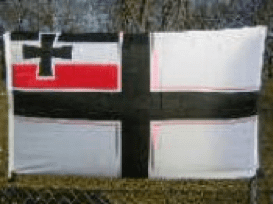
The Imperial German Navy Flag (Reichskriegsflagge) is one of the most striking and historically significant naval war ensigns of the 19th and early 20th centuries — the official battle flag of the Kaiserliche Marine (Imperial German Navy) and the Imperial German Army throughout the era of the German Empire (1871–1918). Bold, immediately recognizable, and steeped in centuries of Prussian and German military tradition, this flag flew from the mastheads of some of the most powerful warships ever built as Germany rose to become the world’s second greatest naval power.
The flag’s design is both visually arresting and historically layered:
A white field provides the primary background — a color drawn directly from the heraldic tradition of the Kingdom of Prussia, whose arms featured the famous black eagle on white, tracing its lineage to the Hohenzollern dynasty and the Holy Roman Empire.
A bold black cross divides the white field — connecting the flag to the ancient heritage of the Teutonic Knights (Deutschritterorden), the medieval German crusading order founded in 1190 that carried the black cross on white across the Baltic and Eastern European crusades of the 13th and 14th centuries. From the Teutonic Knights, the black cross passed into Prussian military identity and ultimately into the Iron Cross — Germany’s most revered military decoration.
In the canton (upper hoist corner) sits the Iron Cross (Eisernes Kreuz) backed by horizontal bands of black, white, and red — the official colors of the German Empire, combining the black and white of Prussia with the red and white of the Hanseatic League trading cities of Northern Germany. This canton design directly references the national flag of the Deutsches Reich, grounding the naval war ensign firmly within the broader identity of the unified German state.
The Reichskriegsflagge was established as the official war flag of the North German Confederation in 1867 — four years before the full unification of Germany — and carried forward unchanged as the war ensign of the German Empire following the proclamation of the Deutsches Reich at the Palace of Versailles on January 18, 1871, following Prussia’s decisive victory in the Franco-Prussian War.
For over 50 years, this flag flew from the warships and army standards of Imperial Germany through some of the most consequential conflicts and naval engagements in modern history:
The Franco-Prussian War (1870–71) — in which Prussia and the German states crushed the French Empire of Napoleon III, captured Paris, and forged a unified German nation in the aftermath of total French defeat.
The Colonial Era (1884–1914) — during which Imperial Germany rapidly assembled a global colonial empire spanning Africa (German East Africa, German Southwest Africa, Kamerun, Togoland), the Pacific (German New Guinea, the Marshall Islands, Samoa), and Asia (Tsingtao, China), with the Reichskriegsflagge flying over German colonial naval stations worldwide.
The Naval Arms Race (1897–1914) — when Admiral Alfred von Tirpitz, appointed by Kaiser Wilhelm II in 1897 to head the Imperial Naval Office, launched the most ambitious naval construction program in German history — building the High Seas Fleet (Hochseeflotte) into the world’s second most powerful navy and triggering a naval arms race with Britain that contributed directly to the outbreak of World War I.
World War I (1914–1918) — in which the Reichskriegsflagge flew through the Battle of Heligoland Bight (1914), the Battle of the Falkland Islands (1914), the Battle of Dogger Bank (1915), and the climactic Battle of Jutland (May 31 – June 1, 1916) — the largest naval battle in history, where over 250 warships and 100,000 sailors clashed in the North Sea in the war’s only major fleet engagement.
The flag was retired with the dissolution of the German Empire following Kaiser Wilhelm II’s abdication on November 9, 1918, and Germany’s Armistice two days later on November 11, 1918.
Q: What happened to the Imperial German Fleet after WWI? Following Germany’s defeat, the High Seas Fleet was interned at the British naval base of Scapa Flow in the Orkney Islands, Scotland. On June 21, 1919 — as the Treaty of Versailles was being finalized — German Rear Admiral Ludwig von Reuter ordered the deliberate scuttling of 52 German warships rather than surrender them to the Allied navies. It remains the largest deliberate scuttling in naval history and the final act performed under the Reichskriegsflagge.
Q: How does this flag differ from other Reichskriegsflagge variants? Several versions of the Reichskriegsflagge were used across different periods. This specific design — with the white field, black cross, and Iron Cross canton with imperial color bands — is the naval war ensign variant, distinct from versions incorporating the Prussian Eagle at the center. Different configurations were used at different periods between 1867 and 1918, making each variant a distinct historical artifact.
Q: What was the Battle of Jutland? The Battle of Jutland (May 31 – June 1, 1916) remains the largest naval battle in history. The German High Seas Fleet inflicted greater losses on the British Grand Fleet in ships and men — but the British retained strategic control of the North Sea, keeping Germany’s fleet effectively blockaded for the rest of the war. The German Navy never again challenged British naval supremacy in a major engagement.
Q: Is this flag associated with the Nazi regime? No — this is an exclusively Imperial German flag, retired in 1918 — fifteen years before the Nazi seizure of power in 1933. It carries no Nazi association and is a straightforward artifact of Imperial German and WWI naval history, making it one of the more historically uncomplicated German military flags for collectors and educators.
Q: What productions feature this flag? The Imperial German War Flag appears in WWI-era productions including Lawrence of Arabia, Gallipoli, The Blue Max, All Quiet on the Western Front, and numerous stage and film productions set during the Imperial German and WWI eras.
Our most popular quality level — durable, lightweight, and built to fly in even the lightest breeze.
“At Ultimate Flags Inc., we are more than just a flag store; we are custodians of history, supporters of freedom, and believers in the power of symbols. Located in O’Brien, Florida, our family-owned business has been serving patriots, history enthusiasts, and flag collectors since 1997. We pride ourselves on offering an unparalleled selection of over 10,000 flags, including American flags, Confederate flags, military flags, historic flags, and custom designs. Each flag tells a story, and we are committed to preserving these narratives through our high-quality products.
Our passion for flags is matched only by our dedication to our customers. Whether you’re seeking a flag for personal expression, historical reenactments, or to honor your heritage, our experienced team is here to help you find the perfect flag. We understand the importance of quality, which is why we offer flags in various materials and sizes, suitable for all needs and occasions.
At Ultimate Flags, we believe in giving back. We actively support veterans, first responders, and non-profit organizations, ensuring that the brave men and women who serve our country are honored and remembered. Our online presence is not just about sales; it’s about educating our audience on the rich tapestry of American history and the significance of flags in our society.
Explore our vast collection in our online flag store and join us in celebrating the virtues, history, and ideas that shape our nation. For Patriots, Pride, & Freedom – Ultimate Flags Inc.”
SKU: [woo_sku]
In the summer of 1812, a group of old soldiers in New York did something that had no military requirement behind it — they picked up their muskets again.
These were veterans of the American Revolution. They had fought the British once, decades earlier, when the country was an idea rather than a nation. Now the British were back, pressing American sailors into their navy, arming Native American tribes against American settlers, and preparing to invade from the north. The veterans of the Revolution were legally exempt from compulsory military service — their age had earned them that relief. They formed up anyway.
The company became known as the Veteran Exempts. Their flag, featuring six-point stars, flew with them to one of the most consequential battles of the war.
The six-point star on this flag reflects an early American vexillological tradition that predates the standardization of the five-pointed star in American flag design. The Continental Congress’s Flag Resolution of 1777 established thirteen stars and thirteen stripes as the national design but did not specify the number of points on each star. Early American flags used both five- and six-point stars interchangeably.
Francis Hopkinson, the New Jersey delegate and designer who also claimed credit for the first Stars and Stripes, favored six-pointed stars in his designs. The famous account of Betsy Ross suggesting five-pointed stars — on the grounds that they could be cut in a single snip — reflects the practical transition toward the five-point standard. But in 1812, that standardization was not yet complete, and militia companies across the new nation flew flags that still carried the older six-point tradition.
The Veteran Exempts flag is a genuine artifact of that transitional moment in American flag history.
On September 11, 1814, the Veteran Exempts were present at what became known as the Battle of Plattsburgh — also called the Battle of Lake Champlain — in the northern reaches of New York State.
The British strategic plan was ambitious: a coordinated land and naval assault down the Lake Champlain corridor that, if successful, would drive deep into American territory and dramatically strengthen Britain’s negotiating position in the peace talks then underway in Ghent, Belgium. Governor-General Sir George Prevost commanded a British land force that significantly outnumbered the American defenders under Brigadier General Alexander Macomb.
The naval engagement decided everything. Commodore Thomas Macdonough had positioned his American fleet in Plattsburgh Bay with extraordinary care — rigging his ships with spring lines on their anchor cables so he could rotate them mid-battle to bring fresh broadsides to bear after one side’s guns were exhausted. When the British naval commander Captain George Downie was killed early in the engagement and his fleet systematically dismantled by Macdonough’s tactical preparation, Prevost had no choice. Without naval control of the lake, his supply lines were severed and his position untenable. He ordered a full retreat back into Canada.
The last British attempt to invade the northern United States was over.
The timing of Plattsburgh could not have been more significant. The peace negotiations at Ghent had stalled, with Britain demanding territorial concessions from the United States. News of the decisive American victory — a smaller force defeating a larger British invasion — arrived at the negotiating table and fundamentally shifted the dynamics. British negotiators, who had hoped for military leverage, found themselves without it.
The Treaty of Ghent was signed on December 24, 1814, restoring pre-war boundaries and ending the conflict. The Veteran Exempts had helped ensure that the country their generation had founded remained intact.
Quality Tier: Standard Quality
Who were the Veteran Exempts? A New York Militia company formed in July 1812, composed entirely of veterans of the American Revolution who were legally exempt from compulsory military service due to their age. They volunteered regardless and saw service during the War of 1812, including at the Battle of Plattsburgh in September 1814.
Why does this flag have six-point stars instead of five? The six-point star reflects an early American design tradition that was still in use during the War of 1812 era. The Continental Congress’s 1777 Flag Resolution established stars and stripes but did not mandate five-point stars specifically — both five- and six-point designs were used in early American flags before the five-point standard became firmly established.
What was the Battle of Plattsburgh? Fought on September 11, 1814, on Lake Champlain in northern New York, it was the decisive engagement that ended the last major British invasion attempt from the north. American Commodore Thomas Macdonough’s naval victory destroyed the British fleet and forced the British land forces to retreat into Canada. The battle significantly influenced the Treaty of Ghent negotiations that ended the War of 1812.
How did Plattsburgh affect the peace negotiations? British negotiators at Ghent had been demanding territorial concessions, expecting military leverage from planned invasions. The decisive American victory at Plattsburgh — combined with the failed attack on Baltimore — eliminated that leverage. The Treaty of Ghent, signed December 24, 1814, restored pre-war boundaries rather than granting Britain the territorial gains it had sought.
Is this flag a historical reproduction? Yes — this flag reproduces the design attributed to the Veteran Exempts company of New York Militia, featuring the six-point star design authentic to the early American flag tradition of the War of 1812 era.
“At Ultimate Flags Inc., we are more than just a flag store; we are custodians of history, supporters of freedom, and believers in the power of symbols. Located in O’Brien, Florida, our family-owned business has been serving patriots, history enthusiasts, and flag collectors since 1997. We pride ourselves on offering an unparalleled selection of over 10,000 flags, including American flags, Confederate flags, military flags, historic flags, and custom designs. Each flag tells a story, and we are committed to preserving these narratives through our high-quality products.
Our passion for flags is matched only by our dedication to our customers. Whether you’re seeking a flag for personal expression, historical reenactments, or to honor your heritage, our experienced team is here to help you find the perfect flag. We understand the importance of quality, which is why we offer flags in various materials and sizes, suitable for all needs and occasions.
At Ultimate Flags, we believe in giving back. We actively support veterans, first responders, and non-profit organizations, ensuring that the brave men and women who serve our country are honored and remembered. Our online presence is not just about sales; it’s about educating our audience on the rich tapestry of American history and the significance of flags in our society.
Explore our vast collection in our online flag store and join us in celebrating the virtues, history, and ideas that shape our nation. For Patriots, Pride, & Freedom – Ultimate Flags Inc.”
SKU: [woo_sku]