


The American flag may be flown every day of the year, but the Flag Code names specific federal holidays when display is especially fitting. Half-staff orders come from the President, a state governor, or the Mayor of D.C., and the flag flies at half-staff on Memorial Day only until noon. The default display window runs from sunrise to sunset, unless the flag is properly illuminated after dark.
TL;DR:
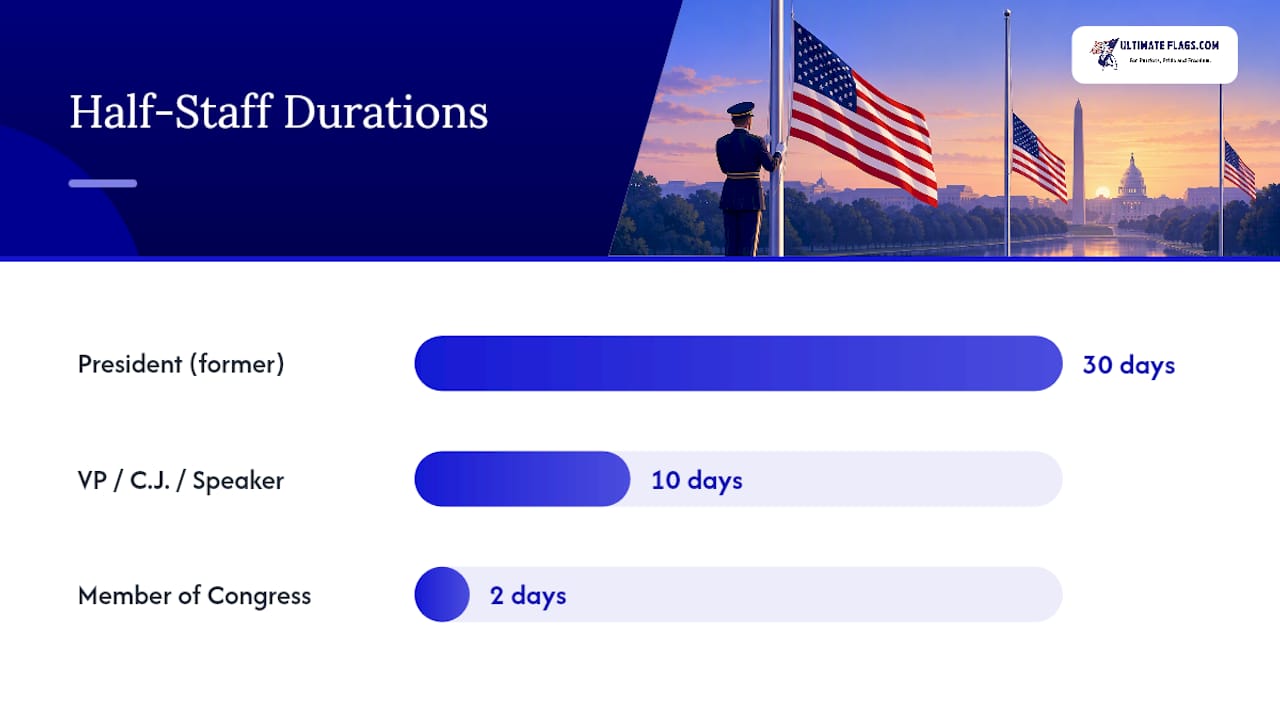
- The President, governors, or mayors can order half-staff for specific durations, with a former President honored for up to 30 days, three times longer than a Vice President.
- Federal holidays like Memorial Day and Veterans Day have strict half-staff and display protocols, including specific timing when the flag should be lowered or raised.
- Proper flag display requires it to be illuminated if flown overnight, weather permitting, and to be positioned correctly based on context such as parades or wall displays.
- The Flag Code is advisory for private citizens, with no federal penalties, but best practices include inspecting flags regularly and retiring them when damaged.
- State-specific flag observances and local orders often supplement federal guidance, so checking official state or local proclamations is recommended for accurate compliance.
Table of Contents
- When to Fly the Flag: Federal Holidays and Recognized Days
- Half-Staff Rules: Who Orders It and How Long It Lasts
- Daily Display Rules: Sunrise, Sunset, and Weather
- Placement and Orientation: Getting the Position Right
- When Not to Fly the Flag
- State and Local Observances Worth Knowing
- Is the Flag Code Mandatory for Private Citizens?
- Flag Care, Inspection, and Retirement Basics
- Why Getting the Details Right Matters
- Where to Find Flags Built for Year-Round Display
- Sources
- FAQ
When to Fly the Flag: Federal Holidays and Recognized Days
The Flag Code names a specific roster of days worth marking on your calendar, and treating that list as a working reference beats guessing year to year. 4 U.S.C. § 6 spells out both fixed-date holidays and observances that shift with the calendar, plus a standing invitation for the President to proclaim additional display days as events warrant.
Some of these dates never move. Independence Day falls on July 4 every year, and Veterans Day sits on November 11 regardless of the day of the week. Others drift. Washington’s Birthday, Memorial Day, and Labor Day follow “which Monday” formulas, while Easter and Mother’s Day depend on lunar and calendar calculations that change annually. If you want to plan ahead by more than a year, the simplest fix is checking a federal holiday calendar each January rather than trying to calculate moving dates yourself.
A few observances deserve special mention because readers often overlook them. National Vietnam War Veterans Day, observed on March 29, honors a generation of veterans whose service went unrecognized for decades. National Korean War Veterans Armistice Day on July 27 marks a conflict that rarely gets the same cultural attention as World War II or Vietnam, yet the flag’s presence on that date carries real weight for surviving veterans and their families. Navy Day on October 27 is a lesser-known observance tied to the U.S. Navy’s founding heritage, often flown by veterans and coastal communities rather than the general public.
Here is the full roster of nationally recognized display days:
- New Year’s Day (January 1)
- Inauguration Day (January 20, every four years)
- Martin Luther King Jr. Day (third Monday in January)
- National Vietnam War Veterans Day (March 29)
- Easter Sunday (variable date)
- Mother’s Day (second Sunday in May)
- Armed Forces Day (third Saturday in May)
- Memorial Day (last Monday in May, half-staff on the morning until noon)
- Flag Day (June 14)
- Father’s Day (third Sunday in June)
- Independence Day (July 4)
- National Korean War Veterans Armistice Day (July 27)
- Labor Day (first Monday in September)
- Constitution Day (September 17)
- Columbus Day (second Monday in October)
- Navy Day (October 27)
- Veterans Day (November 11)
- Thanksgiving Day (fourth Thursday in November)
- Christmas Day (December 25)
Washington’s Birthday and Lincoln’s Birthday deserve a note of their own. Washington’s Birthday is the federally observed holiday, occurring on the third Monday in February, while Lincoln’s Birthday on February 12 is recognized as a display day but is not a federal holiday in most states. The two dates get conflated constantly, and getting them straight matters if you take flag etiquette seriously.
| Observance | Typical Date | Notes |
|---|---|---|
| New Year’s Day | January 1 | Fixed date |
| Lincoln’s Birthday | February 12 | Not a federal holiday; display day only |
| Washington’s Birthday | Third Monday in February | Federal holiday |
| National Vietnam War Veterans Day | March 29 | Fixed date |
| Easter Sunday | Variable | Follows the ecclesiastical lunar calendar |
| Mother’s Day | Second Sunday in May | Variable |
| Armed Forces Day | Third Saturday in May | Variable |
| Memorial Day | Last Monday in May | Half-staff until noon, then full staff |
| Flag Day | June 14 | Fixed date |
| Father’s Day | Third Sunday in June | Variable |
| Independence Day | July 4 | Fixed date |
| National Korean War Veterans Armistice Day | July 27 | Fixed date |
| Labor Day | First Monday in September | Variable |
| Constitution Day | September 17 | Fixed date |
| Columbus Day | Second Monday in October | Variable |
| Navy Day | October 27 | Fixed date |
| Veterans Day | November 11 | Fixed date |
| Thanksgiving Day | Fourth Thursday in November | Variable |
| Christmas Day | December 25 | Fixed date |
State birthdays also earn a place on this list, and the Flag Code specifically names them alongside the federal roster. If your state was admitted to the Union on a date you can look up through your Secretary of State’s office, that day belongs on your personal flag calendar too, right alongside the proper etiquette guidance that governs daily display.
Half-Staff Rules: Who Orders It and How Long It Lasts
Half-staff status is not a casual decision. 4 U.S.C. § 7 reserves that authority for the President of the United States, a state governor, or the Mayor of the District of Columbia, and federal department heads can order it for buildings under their own control. Private citizens cannot legally “declare” half-staff for the nation. They can, however, choose to lower their own flag in solidarity once an official order is issued, which is exactly what most households do when tragedy strikes a community.
Pro Tip: Sign up for your state governor’s office alerts or follow their official social media account. Most half-staff proclamations get announced there hours before local news picks up the story.
The statute sets specific durations depending on who is being honored, and these numbers surprise a lot of people who assume half-staff is a vague, open-ended gesture.
- President or former President: thirty days from the date of death
- Vice President, Chief Justice, or Speaker of the House: ten days from the date of death
- Associate Justice of the Supreme Court, Cabinet member, former Vice President, President pro tempore of the Senate, Majority or Minority Leader of the Senate or House: from death until burial
- Governor of a state, territory, or possession: from death until burial, within that jurisdiction
- Member of Congress: on the day of death and the following day, within that member’s state or district
Half-Staff by the Numbers: A former President is honored for a full 30 days, three times longer than the Vice President’s 10-day period, reflecting the office’s singular weight under federal statute.
Beyond deaths in office, several recurring dates trigger automatic half-staff orders nationwide. Memorial Day is the one most Americans recognize, with the flag lowered from sunrise until noon, then raised to full staff for the remainder of the day, a gesture that mourns the fallen in the morning and celebrates the living nation in the afternoon. Patriot Day on September 11 and Pearl Harbor Remembrance Day on December 7 both call for half-staff by presidential proclamation nearly every year. Peace Officers Memorial Day on May 15 also calls for half-staff, unless it happens to coincide with Armed Forces Day, in which case the more senior observance takes precedence.
The mechanics matter as much as the timing. When lowering a flag to half-staff, the correct procedure is to hoist it briskly all the way to the peak first, pause, and then lower it slowly to the half-staff position. At the end of the day, before taking the flag down entirely, raise it back to the peak momentarily before lowering it for the night. Skipping that first hoist to the peak is one of the most common half-staff mistakes, and it strips the gesture of its intended symbolism: a nation raised high, then deliberately brought low in mourning.
Daily Display Rules: Sunrise, Sunset, and Weather
The standard rule under federal guidance is simple: display the flag from sunrise to sunset. If you want your flag flying around the clock, VA guidelines confirm that continuous display is acceptable as long as the flag is properly illuminated during the hours of darkness. “Properly illuminated” means genuinely visible, not a porch light glancing across the fabric from thirty feet away.
Follow these steps for round-the-clock display without violating the spirit of the guidance:
- Confirm your flagpole has adequate lighting hardware rated for outdoor, continuous use.
- Position a dedicated, focused spotlight aimed directly at the flag rather than relying on ambient street or porch lighting.
- Check the light nightly during the first week to confirm consistent, even illumination across the entire flag.
- Reposition or upgrade the fixture if wind causes the flag to drift outside the light’s beam.
Pro Tip: A single 50-watt LED spotlight is usually enough for a standard residential 3×5-foot flag. Larger flags on commercial poles often need two or more fixtures to avoid dark patches on the fabric.
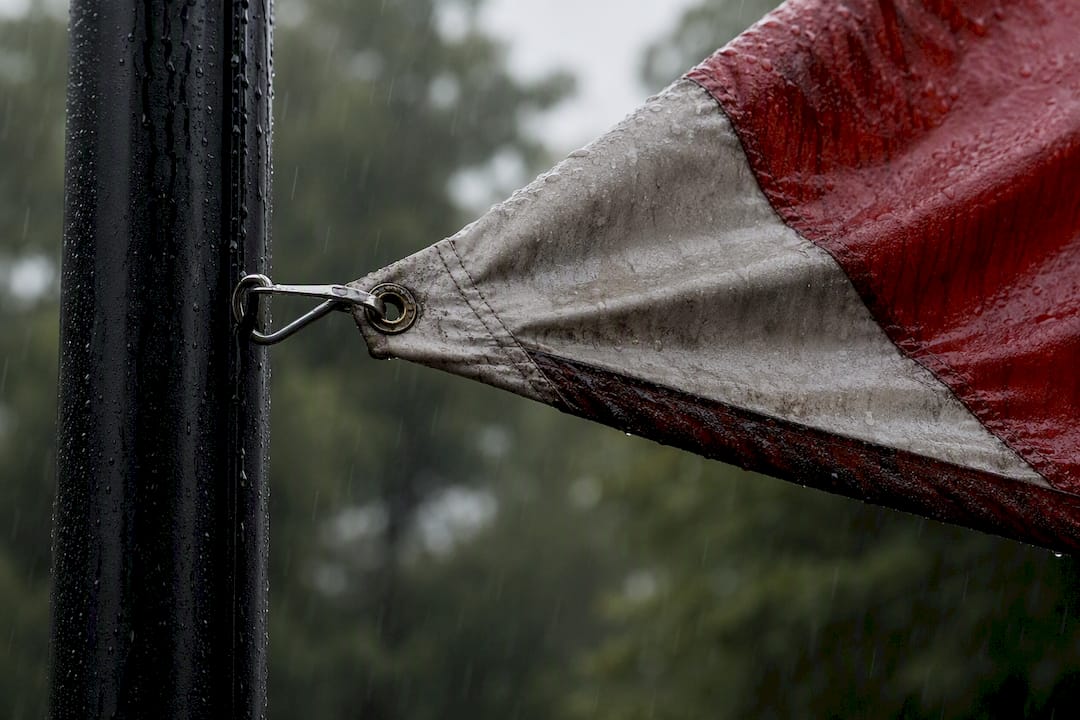
Weather is the other daily variable. The Flag Code and government guidance both advise against flying the flag during inclement weather unless it is constructed from all-weather, heavyweight material designed for exactly that purpose. A soaked cotton or standard nylon flag whipping in high wind degrades fast, and repeated storm exposure shortens its lifespan dramatically. If severe weather rolls through and your flag is not rated for it, bring it in. Nobody’s patriotism is measured by a flag left flapping through a thunderstorm.
Placement and Orientation: Getting the Position Right
Flag position rules exist because the flag’s placement communicates something specific about precedence, and getting it backward is one of the most common etiquette mistakes at parades and public buildings alike.
- In a procession or parade, the U.S. flag goes on the marching right, or centered in front if there’s a line of other flags.
- On a single staff with multiple flags, the U.S. flag sits at the peak, hoisted first and lowered last. It never sits below another flag on the same pole.
- Displayed flat against a wall or in a window, the union (the blue field of stars) goes uppermost and to the observer’s left.
- Hung across a street, the union faces north on an east-west street, or east on a north-south street.
- On a stage or at a lectern, the flag stands to the speaker’s own right, which places it to the audience’s left, and above and behind the speaker as the position of prominence.
These aren’t arbitrary conventions. They trace back to naval and military tradition, where the position of honor has always been to the right, and where the flag leading a formation signals that the formation itself carries the full weight of national authority behind it.
When Not to Fly the Flag
Some situations call for restraint rather than display, and knowing the difference protects both the flag’s dignity and your investment in it.
- Skip flying a standard flag during heavy rain, snow, or high wind unless it’s an all-weather flag built for those conditions.
- Retire a flag once it’s torn, badly faded, or missing grommets rather than continuing to fly a worn one out of habit.
- Remember the Flag Code carries no federal penalty for private citizens, but some HOAs and local ordinances add their own display rules worth checking before you install a pole.
- Never let the flag touch the ground, use it as clothing or drapery, or leave it bunched against a pole in a way that damages the fabric.
Most of these violations happen by accident, not disrespect. A flag dragged briefly on a windy day isn’t a scandal. A flag left flying for months after it’s shredded to ribbons is a different story, and one worth correcting.
State and Local Observances Worth Knowing
Federal law sets the baseline, but governors add their own layer of authority on top of it. A governor can order half-staff for state officials, first responders lost in the line of duty, or local tragedies that never rise to a national proclamation. The Mayor of D.C. holds the same authority within the District.
- State admission or “birthday” dates make appropriate flag-flying days, and most Secretary of State offices publish the exact date.
- Check your governor’s official website or verified social media account for active half-staff proclamations before assuming national guidance applies statewide.
- Usa maintains a running summary of national half-staff orders and links out to state-level resources when local orders diverge from federal ones.
- Local newspapers and city government pages often confirm municipal-level orders faster than national outlets.
If you’re ever uncertain whether a specific date calls for half-staff in your state, five minutes on your governor’s website beats guessing.
Is the Flag Code Mandatory for Private Citizens?
The Flag Code is advisory, not enforceable, when it comes to private citizens flying flags at their own homes. There’s no federal fine for flying your flag past sunset without lighting, or for missing a display day. That said, some states have adopted flag-related statutes with narrow enforcement provisions, and HOA covenants can impose their own rules separate from federal law entirely.
Here’s a practical checklist for staying compliant with the spirit of the guidance without overthinking it:
- Inspect your flag and hardware seasonally for wear, fraying, or pole damage.
- Follow the sunrise-to-sunset rule, or install proper illumination if you want continuous display.
- Watch for official half-staff proclamations through your governor’s office or USA.gov.
- Retire flags once they’re damaged beyond simple repair, rather than letting them fly threadbare.
Nobody is going to knock on your door over a missed holiday. But following these steps keeps your display looking sharp and shows the kind of respect the flag has always been meant to carry.
Flag Care, Inspection, and Retirement Basics
Choosing the right fabric up front saves you from most of the headaches that come later. Standard nylon flags handle everyday wind well and dry quickly after rain, while heavyweight polyester or all-weather blends hold up better through sustained storms and high-wind regions. If your property sits somewhere with brutal winters or coastal gusts, an all-weather flag is worth the upgrade before your first flag shreds in six months.
Run a hands-on inspection every few months, and definitely after any major storm:
- Check grommets for rust, stretching, or tearing away from the header.
- Look at the header seam itself for fraying or separation from the flag body.
- Inspect the fly end (the side away from the pole) for the ragged wear that shows up first.
- Watch for fading, which signals UV damage even before the fabric physically tears.
- Check for mildew spots, especially if the flag has been stored damp after a rain event.
Pro Tip: Rotate a backup flag into service every few months if you fly yours continuously. Alternating two flags roughly doubles the lifespan of each one compared to leaving a single flag up year-round.
Minor fraying at the fly end can sometimes be trimmed and resewn, but once the damage spreads to the stars, stripes, or header, retirement is the respectful choice. For lighting and mounting hardware built for reliable nighttime display, a quality flagpole setup with proper illumination solves the visibility problem permanently rather than leaving you guessing whether your porch light counts.
Why Getting the Details Right Matters
There’s a quiet dignity in doing this correctly. Observing display customs isn’t about rigid rule-following. It’s about making sure Memorial Day’s half-staff hour still means something, that Patriot Day still carries the weight it deserves, and that a flag left up through a hailstorm doesn’t become a symbol of neglect instead of pride.
The practical payoff is real too. Flags that follow proper illumination and weather guidance last years longer than ones flown carelessly. Communities that observe half-staff proclamations together, rather than piecemeal, create a visible, shared moment of remembrance that a scattered, inconsistent display never achieves.
— John Hough
Where to Find Flags Built for Year-Round Display
Following every rule in this guide gets a lot easier when your flag and hardware are built to handle daily wear instead of fighting against it. Ultimate Flags has spent decades as one of the country’s longest-running online flag retailers, stocking American, state, military, and historical flag collections in weights and fabrics suited to everything from calm suburban yards to storm-prone coastlines.

Picking a heavier, all-weather fabric up front means fewer replacements, fewer half-faded flags flying past their prime, and less time spent second-guessing whether tonight’s storm will finish off the one on your pole. Once you’ve got your flag sorted, the next question is usually hardware. Pair it with a properly sized flagpole and mounting setup so illumination and positioning stop being a guessing game. None of this is required to follow the Flag Code. It just makes following it a lot less work. Browse flag collections and pick the fabric that matches your climate before the next holiday rolls around.
Sources
For the legal text behind everything in this guide, these sources carry the actual statutory language and government guidance:
- 4 USC 6: Time and occasions for display
- U.S.C. Title 4 – FLAG AND SEAL, SEAT OF GOVERNMENT, AND THE STATES
- Usa
- Guidelines for Display of the Flag
Check these directly whenever you need the current legal language or an active half-staff proclamation.
FAQ
When Should a Flag Not Be Flown?
Avoid flying a standard flag during heavy rain, snow, or high wind unless it’s made from all-weather material rated for those conditions. A flag that’s torn, badly faded, or missing hardware should also come down for retirement rather than stay displayed in poor condition.
Is the U.S. Flag Supposed to Be on the Right or Left?
In almost every display context, the flag occupies the position of honor on the right, which is the flag’s own right, not the viewer’s. At a lectern or on stage, that places it to the audience’s left while standing to the speaker’s own right, above and behind them.
What Are the Rules for Flying a Flag at Your House?
The Flag Code recommends sunrise-to-sunset display, or continuous display if the flag is properly illuminated at night. It carries no federal penalty for private citizens, though some HOA covenants add their own local requirements.
Is It Disrespectful to Fly a Flag at Night Without a Light?
Government guidance treats unlit nighttime display as something to avoid rather than an outright violation, since the Flag Code recommends bringing the flag down at sunset unless it’s illuminated. The simplest fix is a dedicated spotlight aimed at the flag, or just lowering it each evening and raising it again the next morning.