


“Pirate Calico Jack Rackham Flag Crossed Swords 4 x 6 ft. Standard” has been added to your cart. View cart
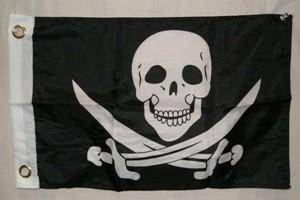
Pirate Calico Jack Rackham Flag Crossed Swords 4 x 6 ft. Standard
$39.95
In stock




Calico Jack Rackham Pirate Flag Skull & Crossed Swords Jolly Roger
The Most Audacious Escape in Caribbean History
Size: 4×6 ft
The harbor at Cuba, sometime around 1720. Calico Jack Rackham’s vessel pinned behind a small island, a Spanish warship blocking the exit, dawn hours away and options running out.
Most captains would have surrendered. Rackham hatched a plan so bold it barely qualified as a plan at all.
Under cover of darkness, he loaded his crew into a small boat, slipped silently around the island, and boarded the captured English sloop the Spanish had anchored nearby — pistols drawn, whispering threats to the skeleton crew aboard that a single sound meant death. By morning, Rackham was already at sea in the stolen vessel. The Spanish warship opened furious cannon fire on the abandoned pirate ship — and only then realized the English sloop had quietly disappeared with the pirates inside it.
That was Calico Jack. All nerve, no hesitation.
The Flag Behind the Legend
Calico Jack’s Jolly Roger is one of the most distinctive and historically documented flags of the Golden Age — a skull in profile over two crossed cutlasses on a black field. Where most pirate flags showed the standard frontal skull with crossbones, Rackham’s design was personal and specific. The swords replaced the bones. The profile skull replaced the frontal stare.
It’s the kind of design choice that suggests deliberate intent — a captain who wanted his flag to be recognizable as his, not just another black Jolly Roger lost in the crowd of pirate imagery.
Anne Bonny, Mary Read, and the Most Unusual Crew Afloat
Much of Rackham’s lasting fame traces not to his own exploits but to the company he kept. Anne Bonny and Mary Read — the two most celebrated female pirates of the Golden Age — both sailed under his colors, and both of them, by most historical accounts, fought harder than the men around them when it mattered most.
Anne Bonny had left her husband in Nassau to sail with Rackham, a scandalous arrangement even by pirate standards. Mary Read, who had spent years disguised as a man in military service before turning to piracy, joined the crew somewhat later. When the Royal Navy finally caught up with Rackham’s vessel in October 1720, his crew was below decks — reportedly incapacitated from drinking — while Bonny and Read were among the only ones who put up any real resistance on deck.
The famous line attributed to Anne Bonny at Rackham’s execution — “if you had fought like a man, you need not have been hanged like a dog” — may be apocryphal, but it has followed his legacy for three centuries regardless.
The Nickname and the Man
Rackham earned the name Calico Jack from his habit of wearing striped calico trousers — calico being an inexpensive printed cotton imported from Calicut, India, that was widely available in Caribbean port markets. It was a small, personal detail that became the defining tag of his identity: a pirate captain named not for his brutality or his plunder, but for his pants.
There’s something fitting about that. Rackham was never the most fearsome or the most prolific pirate of his era. What made him legendary was his audacity, his taste for dramatic escapes, and the extraordinary company he sailed with.
Flag Details & Construction
Quality Tier: Standard Quality
- Size: 4 feet x 6 feet
- Material: Super-weave polyester — 100% synthetic, waterproof
- Print: Through-printed design visible on both sides
- Edges: Double-stitched throughout
- Header: Reinforced brass grommets for easy pole attachment
- Lightweight — flies well in fair-weather breeze
Recommended Uses
- Outdoor fair-weather pole display
- Pirate-themed events, parties, and Renaissance fairs
- Halloween and seasonal decoration
- Man cave, game room, and nautical-themed décor
- Indoor wall display
- Gift for Golden Age of Piracy enthusiasts and maritime history buffs
Frequently Asked Questions
What makes Calico Jack’s flag distinctive from other Jolly Rogers? Rackham’s flag replaced the standard crossbones with two crossed cutlasses and showed the skull in profile rather than frontally. It’s one of the most clearly individualized flag designs of the Golden Age — recognizable as Rackham’s specifically rather than a generic pirate flag.
Who were Anne Bonny and Mary Read? The two most historically documented female pirates of the Golden Age. Both sailed under Rackham’s flag — Anne Bonny as his companion, Mary Read as a crew member who had previously served in military roles disguised as a man. Both were captured with Rackham in 1720. Both were tried for piracy and pleaded pregnancy, escaping immediate execution. Read died in prison; Bonny’s fate after her trial remains historically unresolved.
How was Calico Jack captured? Captain Jonathan Barnet of the Royal Navy intercepted Rackham’s vessel off the coast of Jamaica in October 1720. Much of the crew was reportedly below decks and drunk when the attack came, leaving only a handful — including Bonny and Read — fighting on deck. Rackham was taken alive, tried in Jamaica, and hanged at Gallows Point in Port Royal in November 1720.
Was Calico Jack a major pirate by Golden Age standards? By the numbers, Rackham was a mid-tier operator — not in the same league as Bartholomew Roberts or Henry Every in terms of vessels captured or plunder accumulated. His fame rests more on the dramatic quality of his story: the audacious escapes, the female crew members, the theatrical end. History remembered him larger than his ledger would strictly justify.
Is the 4×6 ft size good for outdoor display? Yes — 4×6 is a step up from the standard 3×5, giving you greater visual presence on taller poles and open outdoor spaces while remaining lightweight enough to fly well in fair-weather conditions.
Shop All Pirate Flags in our Collection!
“At Ultimate Flags Inc., we are more than just a flag store; we are custodians of history, supporters of freedom, and believers in the power of symbols. Located in O’Brien, Florida, our family-owned business has been serving patriots, history enthusiasts, and flag collectors since 1997. We pride ourselves on offering an unparalleled selection of over 10,000 flags, including American flags, Confederate flags, military flags, historic flags, and custom designs. Each flag tells a story, and we are committed to preserving these narratives through our high-quality products.
Our passion for flags is matched only by our dedication to our customers. Whether you’re seeking a flag for personal expression, historical reenactments, or to honor your heritage, our experienced team is here to help you find the perfect flag. We understand the importance of quality, which is why we offer flags in various materials and sizes, suitable for all needs and occasions.
At Ultimate Flags, we believe in giving back. We actively support veterans, first responders, and non-profit organizations, ensuring that the brave men and women who serve our country are honored and remembered. Our online presence is not just about sales; it’s about educating our audience on the rich tapestry of American history and the significance of flags in our society.
Explore our vast collection in our online flag store and join us in celebrating the virtues, history, and ideas that shape our nation. For Patriots, Pride, & Freedom – Ultimate Flags Inc.”
SKU: C18D3F8-RU-FL4x6p-623613
Description
Description
German Naval Jack — Weimar Republic Era (1921–1933), Iron Cross with German Canton, 3×5 Feet
A Rare Flag from Germany’s Most Turbulent Political Era
The German Naval Jack of 1921–1933 is one of the most historically fascinating and collectible flags of the 20th century — a design that bridges the end of the German Empire and the rise of the Third Reich, born entirely within the brief and turbulent years of the Weimar Republic. Featuring the timeless Iron Cross, the traditional black, white, and red imperial colors, and the German national flag in the canton, this jack captures a Germany torn between its imperial past and an uncertain democratic future.
History & Symbolism of the 1921–1933 German Naval Jack
The Weimar Republic (1919–1933) was established in the aftermath of Germany’s defeat in World War I and the abdication of Kaiser Wilhelm II in November 1918. The new democratic government faced an almost impossible task — governing a nation shattered by military defeat, crippled by the punishing Treaty of Versailles (1919), and bitterly divided between monarchists, republicans, communists, and early Nazi agitators.
One of the Weimar Republic’s most politically charged decisions was the question of national colors and flag identity. The new Republic adopted black, red, and gold as its official national colors — the colors of the liberal revolutionary movement of 1848 — replacing the black, white, and red of the German Empire. This decision was fiercely contested by German nationalists and monarchists, who viewed the new colors as a humiliating repudiation of imperial German heritage.
The German Naval Jack adopted in 1921 reflected this political compromise — incorporating the black, white, and red of the old imperial tradition alongside the new republican identity. Its design combined:
- The black, white, and red field — the colors of the Prussian and imperial German heraldic tradition, drawn from the arms of the Hohenzollern dynasty and the Hanseatic League, representing continuity with Germany’s pre-Weimar military and naval heritage
- A bold black Iron Cross (Eisernes Kreuz) centered on the flag — Germany’s most venerated military symbol, established in 1813 during the Napoleonic Wars and carried through the Franco-Prussian War and World War I as the nation’s premier decoration for battlefield valor
- The German national flag in the canton (upper hoist corner) — incorporating the black, red, and gold tricolor of the Weimar Republic, formally acknowledging the new democratic state’s authority while surrounding it with imperial colors that many in the German Navy still preferred
This design tension — republican colors in the canton, imperial colors dominating the field — perfectly encapsulates the fundamental instability of the Weimar Republic itself, which was perpetually caught between democratic legitimacy and the gravitational pull of its imperial past.
The flag was in use from 1921 until 1933, when Adolf Hitler’s appointment as Chancellor and the subsequent Nazi seizure of power (Machtergreifung) brought an end to the Weimar Republic and its flag designs. The black, red, and gold republican tricolor was abolished and replaced with the black, white, and red of the imperial era — and ultimately the swastika flag — as the Nazis deliberately reclaimed imperial German symbolism and rejected the Weimar democratic heritage entirely.
Frequently Asked Questions & Little-Known Facts
Q: Why did the Weimar Republic keep imperial colors in its naval jack? The German Navy (Reichsmarine) of the Weimar era was deeply conservative and largely monarchist in its officer culture — a reflection of the Imperial German Navy’s traditions and the class backgrounds of its officers. The retention of black, white, and red in the naval jack was a political concession to naval tradition and to the powerful nationalist factions within German society who refused to accept the republican colors as legitimate.
Q: What was the Weimar Republic and why did it fail? The Weimar Republic (1919–1933) was Germany’s first democratic government — established under enormous pressure following WWI defeat, burdened from birth by the “stab-in-the-back” myth promoted by German nationalists who falsely blamed civilian politicians for Germany’s military defeat. It survived multiple crises — the hyperinflation of 1923, multiple coup attempts including Hitler’s Beer Hall Putsch (1923), and the devastating Great Depression (1929) — before finally collapsing when President Paul von Hindenburg appointed Hitler as Chancellor in January 1933.
Q: What happened to the Weimar Republic’s black, red, and gold flag? Upon the Nazi seizure of power in 1933, the black, red, and gold tricolor was immediately abolished and replaced with the imperial black, white, and red — and then progressively with the swastika flag. The black, red, and gold was restored as Germany’s national flag following World War II and remains the flag of the Federal Republic of Germany today.
Q: What is the Iron Cross’s significance in this flag? The Iron Cross on this jack connects the Weimar Republic’s naval identity directly to 800 years of German military heritage — from the Teutonic Knights of the 13th century through the Napoleonic Wars, the Franco-Prussian War, and World War I. Its presence on a republican-era flag was a deliberate statement that the new Germany, whatever its political form, maintained continuity with the military traditions and sacrifices of the old.
Q: Is this flag associated with the Nazi regime? No — this flag was retired in 1933 when the Nazis came to power and abolished Weimar-era symbols. It is an exclusively Weimar Republic era design with no direct Nazi association, making it one of the more historically straightforward German flags of the early 20th century for collectors and historians.
Standard Quality — Super-Weave Polyester, 3×5 Feet
Our most popular quality level — durable, lightweight, and built to fly in even the lightest breeze.
- Through-dyed on both sides — design fully visible from either direction
- Bright, fade-resistant dye for lasting color in indoor and fair-weather outdoor use
- 100% synthetic super-weave polyester — lightweight, waterproof, and highly responsive in minimal wind
- Double-stitched edges on all sides for lasting durability
- Reinforced grommet holes with metal rings for secure, rust-free pole attachment
- Fits any standard flagpole or mounting system
Recommended Uses
- Weimar Republic and WWI-era reenactments and living history events
- Theatrical productions — film, television, and stage
- Indoor museum and historical displays
- Academic and educational exhibitions
- Collectors of Imperial German, Weimar Republic, and early 20th century German naval history
- Fair-weather outdoor display, events, and parades
Premium Quality Cotton Polehem Sewn Nazi Banner 3 x 5
See Nazi Germany Flag Collection Here.
Check out our entire WW2 Nazi Flag Collection Here.
We are adding more and more daily!
“At Ultimate Flags Inc., we are more than just a flag store; we are custodians of history, supporters of freedom, and believers in the power of symbols. Located in O’Brien, Florida, our family-owned business has been serving patriots, history enthusiasts, and flag collectors since 1997. We pride ourselves on offering an unparalleled selection of over 10,000 flags, including American flags, Confederate flags, military flags, historic flags, and custom designs. Each flag tells a story, and we are committed to preserving these narratives through our high-quality products.
Our passion for flags is matched only by our dedication to our customers. Whether you’re seeking a flag for personal expression, historical reenactments, or to honor your heritage, our experienced team is here to help you find the perfect flag. We understand the importance of quality, which is why we offer flags in various materials and sizes, suitable for all needs and occasions.
At Ultimate Flags, we believe in giving back. We actively support veterans, first responders, and non-profit organizations, ensuring that the brave men and women who serve our country are honored and remembered. Our online presence is not just about sales; it’s about educating our audience on the rich tapestry of American history and the significance of flags in our society.
Explore our vast collection in our online flag store and join us in celebrating the virtues, history, and ideas that shape our nation. For Patriots, Pride, & Freedom – Ultimate Flags Inc.”
SKU: C21D1F7-RU-FL3X5P-354-830363
Recently Viewed Flags
No reviews to show
 Unhappy With Your Product? We’ll Take It Back!