


“Pirate Flag Time Flies When You’re Having Rum Flag 3 X 5 ft. Standard” has been added to your cart. View cart
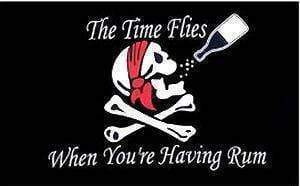
Pirate Flag Time Flies When You’re Having Rum Flag 3 X 5 ft. Standard
$24.95
In stock




Pirate Flag — “Time Flies When You’re Having Rum,” 3×5 Feet, Standard Polyester
The Undeniable Truth of Life at Sea — Now on a Flag
Time Flies When You’re Having Rum — a philosophical observation so universally accurate that it required no further elaboration from the pirates, privateers, and naval sailors who lived by it for three centuries. This flag captures the spirit of the Golden Age of Piracy’s most important supply chain with the clarity and directness that only a skull and a great pun can deliver. Fly it proudly. The rum is already poured.
The History of Rum & the Sea — A Love Story Three Centuries in the Making
No substance in maritime history is more deeply, more completely, or more gloriously intertwined with the culture of sailors, pirates, and naval warfare than rum. The story of rum at sea is the story of the Caribbean, the British Empire, the slave trade, the Golden Age of Piracy, and three centuries of men finding creative ways to make ocean life bearable — all distilled into a single bottle.
The Birth of Rum in the Caribbean
Rum was born in the Caribbean in the early 17th century — a byproduct of the sugar plantation economy that had taken root across the islands following European colonization. Sugar cane processing produced vast quantities of molasses — a dark, thick byproduct of sugar refining that had little commercial value on its own. Plantation workers, possibly drawing on earlier fermentation traditions, discovered that molasses could be fermented and distilled into a potent spirit.
The earliest documented reference to Caribbean rum appears in a 1651 Barbados document describing the island’s primary drink with magnificent alarm: “The chief fuddling they make in the island is Rumbullion, alias Kill-Divil, and this is made of sugar canes distilled, a hot, hellish, and terrible liquor.” Kill-Devil — one of rum’s earliest and most evocative nicknames — captured perfectly the drink’s reputation among those encountering it for the first time. It was cheap, it was powerful, and it was everywhere.
By the mid-1600s rum had become the dominant spirit of the Caribbean and one of the most important trade goods in the Atlantic economy — shipped in enormous quantities to Britain, the American colonies, and West Africa, where it formed one leg of the infamous Triangular Trade.
The British Navy & the Sacred Daily Tot
After Admiral William Penn (father of Pennsylvania founder William Penn) led the British capture of Jamaica in 1655, the Royal Navy made one of the most consequential procurement decisions in its history — switching its sailors’ daily alcohol ration from French brandy to Jamaican rum.
From that moment, rum became an official and sacred institution of the Royal Navy. Every sailor received a daily “tot” — a standard measure of rum — as a guaranteed part of his rations, issued with the same certainty as food and pay. The tot was more than a drink. It was a morale institution, a social ritual, a painkiller, and in an era before reliable fresh water supplies, occasionally a medical necessity.
In 1740, Admiral Edward Vernon — nicknamed “Old Grog” for his grogram boat cloak — ordered that sailors’ rum rations be diluted with water and mixed with citrus juice, specifically lime juice, to combat the devastating ravages of scurvy that killed more Royal Navy sailors than combat. The resulting mixture became universally known as “grog” — both solving a nutritional deficiency and inadvertently making the British Navy’s sailors the healthiest at sea. The discovery that citrus prevented scurvy was one of the most important public health advances of the 18th century, and it came directly from watering down rum.
The Royal Navy’s daily rum tot continued uninterrupted for over 300 years — through every war, every ocean, every era of naval history — until it was finally discontinued on July 31, 1970. The date is still solemnly observed in the Royal Navy as “Black Tot Day” — the day the tot died. Sailors marked the occasion by wearing black armbands, holding mock funeral processions for their rum tots, and mourning what many regarded as the end of an era of genuine naval tradition. Some wept.
Pirates, Rum & Port Royal — The Wickedest City on Earth
For pirates of the Golden Age, rum occupied an even more central role than it did for their naval counterparts — not merely as a daily ration but as currency, motivation, medicine, and the primary attraction of the ports they called home.
Port Royal, Jamaica — before its catastrophic destruction in the earthquake of June 7, 1692, which killed an estimated 2,000 people and caused much of the city to slide into the sea — was the most notorious pirate port in the Caribbean and one of the most lawless cities in the world. Its streets were packed with taverns, brothels, and rum shops catering to the pirates, privateers, and buccaneers who flooded the island with captured wealth.
Jamaica’s early governors, lacking adequate Royal Navy support to defend the island from Spanish attack, had made a pragmatic deal with the pirate community — offering Port Royal as a safe harbor for fencing stolen goods and spending ill-gotten gains in exchange for the pirates’ military support against Spanish incursions. The result was a city awash in captured treasure and Jamaican rum in roughly equal proportions.
Sir Henry Morgan — the greatest buccaneer who ever lived, who had sacked Panama City and earned a knighthood and the position of Lieutenant Governor of Jamaica — spent his final years in Port Royal’s taverns, drinking rum and reliving his glory days in what Caribbean sailors called “the sweet trade.” He drank himself to death there, his liver finally surrendering what Spanish warships, jungle marches, and the Royal Navy had been unable to defeat. Port Royal earned its permanent reputation as the “wickedest city on earth” — a title its citizens apparently regarded with civic pride.
Rum as Currency, Medicine & Obsession
The relationship between pirates and rum went considerably beyond casual enjoyment. Rum functioned as actual currency in the Caribbean economy for periods of the 17th and 18th centuries — accepted in payment for goods and services with the same reliability as silver coins. In the American colonies, rum distilled from Caribbean molasses became one of the most important industries in Massachusetts and Rhode Island, and the colonial rum trade was so economically significant that British taxation of molasses under the Molasses Act of 1733 and its successor the Sugar Act of 1764 became major grievances driving colonial resistance to British rule — making rum one of the indirect causes of the American Revolution.
For pirates specifically, rum’s hold could become genuinely pathological. Contemporary accounts describe pirate crews becoming so dependent on their rum supply that running out was considered a cause for desperate action — including attacking vessels that had previously been placed off-limits by pirate agreement. The hallucinations and physical distress of rum withdrawal were documented by observers who noted that pirates deprived of their supply became dangerously unpredictable. Blackbeard famously maintained his terrifying presence in part through extraordinary rum consumption, weaving slow-burning fuses into his beard and drinking himself into states that made him appear genuinely supernatural to his crew.
“Fifteen Men on a Dead Man’s Chest” — Rum’s Most Famous Literary Moment
No piece of writing has done more to cement the connection between pirates and rum than Robert Louis Stevenson’s immortal sea chanty from Treasure Island (1883):
“Fifteen men on a dead man’s chest, Yo ho ho and a bottle of rum! Drink and the devil be done with the rest, Yo ho ho and a bottle of rum!”
A chanty (also spelled shanty) is a work song originally sung by sailors while performing coordinated physical labor — hauling lines, working capstans, or pumping bilges — with a solo voice singing the verses and the crew joining on the chorus to synchronize their effort. Stevenson’s version became the most famous sea chanty ever written and fixed the bottle of rum permanently in the popular imagination as the essential pirate accessory — a position it has occupied without serious challenge ever since.
Frequently Asked Questions & Little-Known Facts
Q: What does “Kill-Devil” mean as a name for rum? Kill-Devil — from the 1651 Barbados document describing rum as “a hot, hellish, and terrible liquor” — was one of the earliest recorded names for Caribbean rum, reflecting the drink’s reputation for extraordinary potency among those encountering it for the first time. The name suggests the spirit was strong enough to kill whatever devils might be afflicting the drinker — or possibly to create new ones.
Q: What is “Black Tot Day” and is it still observed? Black Tot Day — July 31, 1970 — marks the last day the Royal Navy issued its traditional daily rum ration to sailors, ending a tradition that had lasted over 315 years. It is still informally observed by Royal Navy veterans and enthusiasts worldwide, typically by drinking rum in commemoration. Several British rum producers release special Black Tot Day editions annually.
Q: What is grog and where does the name come from? Grog — the mixture of water, rum, and citrus juice ordered by Admiral Edward Vernon in 1740 — takes its name from Vernon’s nickname “Old Grog,” derived from his distinctive grogram (a coarse fabric) boat cloak. The word subsequently entered the English language as a general term for any alcoholic drink, and “groggy” — meaning unsteady or confused — derives directly from the effects of excessive grog consumption.
Q: Did rum really prevent scurvy? Not directly — it was the citrus juice added to grog that prevented scurvy by providing Vitamin C. The rum and water simply made the citrus juice palatable enough that sailors would actually drink it. The Royal Navy’s use of lime juice earned British sailors the lasting nickname “Limeys” — a term still occasionally used today.
Q: Is Port Royal really at the bottom of the sea? Partially — the earthquake and tsunami of June 7, 1692 caused approximately two-thirds of Port Royal to slide into Kingston Harbor, taking an estimated 2,000 lives and most of the city’s buildings with it. The submerged portion of Port Royal has been the subject of underwater archaeological excavations since the 1960s and remains one of the best-preserved 17th century urban sites in the world — a perfectly pickled pirate city preserved in Caribbean mud.
Standard Quality — Super-Weave Polyester, 3×5 Feet
Our most popular quality level — durable, lightweight, and built to fly well in even the lightest breeze.
- Through-dyed on both sides — design fully visible from either direction
- Bright, fade-resistant dye for lasting color in indoor and fair-weather outdoor use
- 100% synthetic waterproof super-weave polyester — lightweight and highly responsive in minimal wind
- Double-stitched edges on all sides for lasting durability
- Reinforced grommet holes with metal rings for secure, rust-free pole attachment
- Fits any standard flagpole or mounting system
Recommended Uses
- Gasparilla Festival and pirate-themed events and parades
- Boats, docks, tiki bars, and nautical display
- Fair-weather outdoor pole display
- Bars, restaurants, man caves, and entertainment spaces
- Indoor display and home decoration
- Halloween parties and seasonal themed decoration
- Gifts for rum enthusiasts, sailors, and anyone who appreciates the finer points of maritime beverage history
Check out our full Pirate Flag Collection Here
“At Ultimate Flags Inc., we are more than just a flag store; we are custodians of history, supporters of freedom, and believers in the power of symbols. Located in O’Brien, Florida, our family-owned business has been serving patriots, history enthusiasts, and flag collectors since 1997. We pride ourselves on offering an unparalleled selection of over 10,000 flags, including American flags, Confederate flags, military flags, historic flags, and custom designs. Each flag tells a story, and we are committed to preserving these narratives through our high-quality products.
Our passion for flags is matched only by our dedication to our customers. Whether you’re seeking a flag for personal expression, historical reenactments, or to honor your heritage, our experienced team is here to help you find the perfect flag. We understand the importance of quality, which is why we offer flags in various materials and sizes, suitable for all needs and occasions.
At Ultimate Flags, we believe in giving back. We actively support veterans, first responders, and non-profit organizations, ensuring that the brave men and women who serve our country are honored and remembered. Our online presence is not just about sales; it’s about educating our audience on the rich tapestry of American history and the significance of flags in our society.
Explore our vast collection in our online flag store and join us in celebrating the virtues, history, and ideas that shape our nation. For Patriots, Pride, & Freedom – Ultimate Flags Inc.”
SKU: C34D5F3-RU-FL3X5P-294-832909-83809
Description
Description
German Naval Jack — Weimar Republic Era (1921–1933), Iron Cross with German Canton, 3×5 Feet
A Rare Flag from Germany’s Most Turbulent Political Era
The German Naval Jack of 1921–1933 is one of the most historically fascinating and collectible flags of the 20th century — a design that bridges the end of the German Empire and the rise of the Third Reich, born entirely within the brief and turbulent years of the Weimar Republic. Featuring the timeless Iron Cross, the traditional black, white, and red imperial colors, and the German national flag in the canton, this jack captures a Germany torn between its imperial past and an uncertain democratic future.
History & Symbolism of the 1921–1933 German Naval Jack
The Weimar Republic (1919–1933) was established in the aftermath of Germany’s defeat in World War I and the abdication of Kaiser Wilhelm II in November 1918. The new democratic government faced an almost impossible task — governing a nation shattered by military defeat, crippled by the punishing Treaty of Versailles (1919), and bitterly divided between monarchists, republicans, communists, and early Nazi agitators.
One of the Weimar Republic’s most politically charged decisions was the question of national colors and flag identity. The new Republic adopted black, red, and gold as its official national colors — the colors of the liberal revolutionary movement of 1848 — replacing the black, white, and red of the German Empire. This decision was fiercely contested by German nationalists and monarchists, who viewed the new colors as a humiliating repudiation of imperial German heritage.
The German Naval Jack adopted in 1921 reflected this political compromise — incorporating the black, white, and red of the old imperial tradition alongside the new republican identity. Its design combined:
- The black, white, and red field — the colors of the Prussian and imperial German heraldic tradition, drawn from the arms of the Hohenzollern dynasty and the Hanseatic League, representing continuity with Germany’s pre-Weimar military and naval heritage
- A bold black Iron Cross (Eisernes Kreuz) centered on the flag — Germany’s most venerated military symbol, established in 1813 during the Napoleonic Wars and carried through the Franco-Prussian War and World War I as the nation’s premier decoration for battlefield valor
- The German national flag in the canton (upper hoist corner) — incorporating the black, red, and gold tricolor of the Weimar Republic, formally acknowledging the new democratic state’s authority while surrounding it with imperial colors that many in the German Navy still preferred
This design tension — republican colors in the canton, imperial colors dominating the field — perfectly encapsulates the fundamental instability of the Weimar Republic itself, which was perpetually caught between democratic legitimacy and the gravitational pull of its imperial past.
The flag was in use from 1921 until 1933, when Adolf Hitler’s appointment as Chancellor and the subsequent Nazi seizure of power (Machtergreifung) brought an end to the Weimar Republic and its flag designs. The black, red, and gold republican tricolor was abolished and replaced with the black, white, and red of the imperial era — and ultimately the swastika flag — as the Nazis deliberately reclaimed imperial German symbolism and rejected the Weimar democratic heritage entirely.
Frequently Asked Questions & Little-Known Facts
Q: Why did the Weimar Republic keep imperial colors in its naval jack? The German Navy (Reichsmarine) of the Weimar era was deeply conservative and largely monarchist in its officer culture — a reflection of the Imperial German Navy’s traditions and the class backgrounds of its officers. The retention of black, white, and red in the naval jack was a political concession to naval tradition and to the powerful nationalist factions within German society who refused to accept the republican colors as legitimate.
Q: What was the Weimar Republic and why did it fail? The Weimar Republic (1919–1933) was Germany’s first democratic government — established under enormous pressure following WWI defeat, burdened from birth by the “stab-in-the-back” myth promoted by German nationalists who falsely blamed civilian politicians for Germany’s military defeat. It survived multiple crises — the hyperinflation of 1923, multiple coup attempts including Hitler’s Beer Hall Putsch (1923), and the devastating Great Depression (1929) — before finally collapsing when President Paul von Hindenburg appointed Hitler as Chancellor in January 1933.
Q: What happened to the Weimar Republic’s black, red, and gold flag? Upon the Nazi seizure of power in 1933, the black, red, and gold tricolor was immediately abolished and replaced with the imperial black, white, and red — and then progressively with the swastika flag. The black, red, and gold was restored as Germany’s national flag following World War II and remains the flag of the Federal Republic of Germany today.
Q: What is the Iron Cross’s significance in this flag? The Iron Cross on this jack connects the Weimar Republic’s naval identity directly to 800 years of German military heritage — from the Teutonic Knights of the 13th century through the Napoleonic Wars, the Franco-Prussian War, and World War I. Its presence on a republican-era flag was a deliberate statement that the new Germany, whatever its political form, maintained continuity with the military traditions and sacrifices of the old.
Q: Is this flag associated with the Nazi regime? No — this flag was retired in 1933 when the Nazis came to power and abolished Weimar-era symbols. It is an exclusively Weimar Republic era design with no direct Nazi association, making it one of the more historically straightforward German flags of the early 20th century for collectors and historians.
Standard Quality — Super-Weave Polyester, 3×5 Feet
Our most popular quality level — durable, lightweight, and built to fly in even the lightest breeze.
- Through-dyed on both sides — design fully visible from either direction
- Bright, fade-resistant dye for lasting color in indoor and fair-weather outdoor use
- 100% synthetic super-weave polyester — lightweight, waterproof, and highly responsive in minimal wind
- Double-stitched edges on all sides for lasting durability
- Reinforced grommet holes with metal rings for secure, rust-free pole attachment
- Fits any standard flagpole or mounting system
Recommended Uses
- Weimar Republic and WWI-era reenactments and living history events
- Theatrical productions — film, television, and stage
- Indoor museum and historical displays
- Academic and educational exhibitions
- Collectors of Imperial German, Weimar Republic, and early 20th century German naval history
- Fair-weather outdoor display, events, and parades
Premium Quality Cotton Polehem Sewn Nazi Banner 3 x 5
See Nazi Germany Flag Collection Here.
Check out our entire WW2 Nazi Flag Collection Here.
We are adding more and more daily!
“At Ultimate Flags Inc., we are more than just a flag store; we are custodians of history, supporters of freedom, and believers in the power of symbols. Located in O’Brien, Florida, our family-owned business has been serving patriots, history enthusiasts, and flag collectors since 1997. We pride ourselves on offering an unparalleled selection of over 10,000 flags, including American flags, Confederate flags, military flags, historic flags, and custom designs. Each flag tells a story, and we are committed to preserving these narratives through our high-quality products.
Our passion for flags is matched only by our dedication to our customers. Whether you’re seeking a flag for personal expression, historical reenactments, or to honor your heritage, our experienced team is here to help you find the perfect flag. We understand the importance of quality, which is why we offer flags in various materials and sizes, suitable for all needs and occasions.
At Ultimate Flags, we believe in giving back. We actively support veterans, first responders, and non-profit organizations, ensuring that the brave men and women who serve our country are honored and remembered. Our online presence is not just about sales; it’s about educating our audience on the rich tapestry of American history and the significance of flags in our society.
Explore our vast collection in our online flag store and join us in celebrating the virtues, history, and ideas that shape our nation. For Patriots, Pride, & Freedom – Ultimate Flags Inc.”
SKU: C21D1F7-RU-FL3X5P-354-830363
Recently Viewed Flags

Anonymous
 Customer
5/5
I only hung the 1 flag outa 3 flags I got delivery was fast I like the flags wish they had more seasonal flags
1 week ago

 Unhappy With Your Product? We’ll Take It Back!